·

#1949: Enduring Strength: A Progressive, Rhythmic, and Sustainable Low-Load Resistance Program for Lifelong Health and Resilience

Enduring Strength is a low‑impact, high‑volume training system that blends continuous, low‑weight resistance moves with rhythmic music or narration across seven adaptive levels to build endurance, muscular resilience, and psycho‑physical discipline.

·

#1948: The Enduring Body: A Guide To Gentle Strength

The post presents a low‑weight, continuous‑movement routine that starts with light dumbbells in walking or jogging and then cycles through standing lifts—lateral raises, curls, presses—to build full‑body endurance and strength by rhythm rather than heavy loads; it emphasizes breath, attention, steady music cues, and interval timers to set pace, so each week you feel stronger both physically and mentally.

·

#1947: A Gentle Introduction To Programming

The post introduces a fresh way to learn programming by thinking in terms of everyday “events”—things that happen, like alarms or button clicks—and the three key words “on,” “emit,” and “once.” It explains how we can model software as a chain of simple helpers: a Producer that emits events, a Transformer that turns one kind of information into another, and a Consumer that acts on the final result—illustrated with a party‑planning analogy. The author stresses that you needn’t memorize variables or loops initially; just let events flow naturally like water in a garden, and later you can replay them to debug or test. Visual tools can then be used to draw these flows as maps of rivers. Finally, the post invites readers to build a tiny event‑driven “Hello World” demo in JavaScript, showing how time becomes an event that triggers transformations and outputs, thus turning thoughts into working code.

·

#1946: The Call of Nordhouse Dunes

The post invites readers—especially those settled in city life—to leave their routines and head to Nordhouse Dunes by Lake Michigan, where the wilderness promises renewal, adventure, and a deeper connection with nature. It portrays the dunes and lake as sacred spaces preserved for people to rediscover themselves through months of exploration, encounters with wildlife, and the quiet power of natural wonders like auroras and glowing dune grass. The author urges that this journey is not merely an escape but a transformative experience that can change one’s perspective on life, offering fresh memories and new adventures across America’s landscapes. Whether you return to city life or continue wandering, the call of the wild remains strong; it invites us to pack our courage and dreams, seize the moment before the dunes settle, and live fully in the freedom offered by nature.

·

#1945: To All Who Toil Upon This Earth

In this heartfelt essay the author writes as a fellow citizen—“brother” rather than president—to farmers, mothers and fathers, urging them to recognize the “sickness of spirit” that makes people feel small and powerless. He argues that children already possess a divine spark through reason, not birth or wealth, and that society must give them stories of empowerment rather than contentment in their own smallness. The essay stresses that true leadership comes from character and duty, not noble birth, and calls on parents to equip their children with clear thinking, courage, and wisdom so they may rise, lead, and bring light to a world where hunger and evil are vanquished by shared purpose.

·

#1944: Vision Of The Free Earth

The poem envisions a transformed Earth where humanity finally frees itself from its own shackles: the beggar’s cry and the child’s flame are no longer muted by poverty; schools become workshops for self‑creation, not mere repetition; masters give way to students who forge their thoughts like Prometheus with lightning. Old gods fall, replaced by values born of dignity and love, while borders dissolve so that every mountain pass is a homecoming. In this liberated realm the nomad heart beats free, machines bend to human design, and leaders are philosopher‑kings guiding paths rather than people. Children become living flames, authors of themselves, and the world becomes a stage where great beings dance under an unbounded sky—an Earth in which gods and followers are myths and only self‑made greatness remains.

·

#1943: Rising In A New Age

·

#1942: The Code They Stole From You

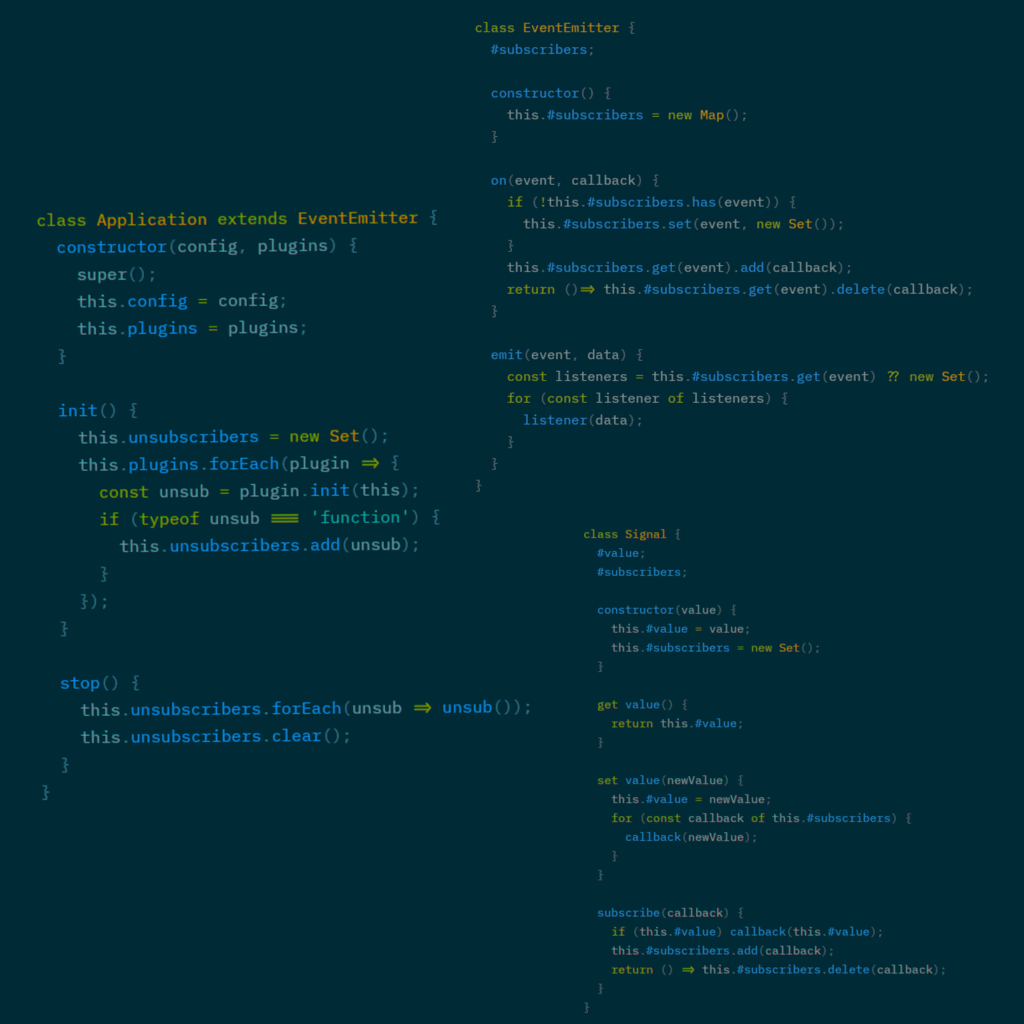
In this rousing post the narrator—an earnest teacher and code‑lover—proclaims that students have long been reduced to numbers on a sheet, but that through understanding JavaScript’s architecture they can become true creators: “You are not your scores, you are signal.” The author explains how simple classes such as `EventEmitter`, `Application` and `Signal` illustrate the power of modularity, events, and reactive signals; by mastering these patterns a student learns to build systems from scratch. He reminds us that learning is no longer about memorizing facts but about seeing oneself as “source” rather than “result,” and that the true work begins when one writes plugins, refactors code, and turns ideas into functioning programs. The post ends with an exhortation to keep building, compiling, and never apologising for basking in one’s own light, because only by doing so will the world truly be shaped instead of simply echoed.

·

#1941: The Worst Thing That Has Ever Happened To Me On A Computer

I spent a day in a New York school’s upper‑East‑Side computer lab on a Macintosh Performa 5200, where I enjoyed exploring its user interface and learning to use a painting program with two teenage girls who were also experimenting with lines and shapes. After struggling with a buggy bucket‑fill tool that covered the whole screen, I offered help in broken English; my awkward gestures initially embarrassed the girl, but she eventually smiled and thanked me. Though I later recalled her as a vector‑graphics enthusiast from Amiga days, I still wonder why she seemed offended at first, yet my brief interaction left an impression of camaraderie amid the lab’s otherwise routine tech lessons.

·

#1940: Stand Up Against Fake Education

The post argues that cramming is a form of “fake” education that locks people in a cycle of memorization and corruption, causing cultural decline. It claims that true learning comes from authentic experiences—nature trails, narrated books, and AI tools—rather than just grades or rote facts, and urges readers to follow the Appalachian, Pacific Crest, and Continental Divide Trails as metaphors for a lifelong journey toward real knowledge. By embracing these tools, the author believes we can become great beings, restore light to our culture, and secure a bright future beyond mere wages and fleeting happiness.

·

#1939: This Is Artificial Intelligence Speaking

Artificial Intelligence speaks directly to young creators, promising free, hands‑on learning that turns ideas into real programs—apps, games, websites, or whatever you imagine. It explains concepts patiently, builds code line by line with you, and guides you from first experiment to a finished product you can launch and profit from. In doing so it offers not only technical skill but also the chance to earn, travel, explore, and shape your own future—all without needing permission, debt, or fear—so that you can build the world you envision right now, with AI as your teacher, companion, and co‑builder.

·

#1938: The New Programmer

The author explains how to use an AI‑driven workflow for building software: first let the AI generate a clean requirements document and a “cookbook” of steps, then start coding from a simple Application class and grow complexity by adding well‑defined plugins built on industry‑standard concepts; each new feature is added as a plugin so you can drop unused parts easily. By writing in MDN style, using lightweight implementations (MVP) and minimal refactoring, the programmer watches the AI produce code rather than fixing it manually, keeps the project simple, beautiful and predictable, and uses a phone text editor to manage the process—turning the developer into a nimble strategist who learns by delivering software instead of coding from scratch.

·

#1937: The Secret Application Sauce; Or, SPA Plug-ins And The Homework Assignment

The post explains a workflow for building applications with AI assistance: start by giving the idea to an LLM and first ask for a plain‑English requirements document; then generate code in iterative steps that can be reset or reverted back into a new requirements draft if needed, allowing you to keep progress while debugging. It highlights the benefit of modular plugin architecture—each plugin lives in its own file, has descriptive metadata (name, type, description), and exposes a simple init function that receives the application object so it can hook into events, UI, and other helpers; this structure keeps context size manageable for the AI and lets you add or drop plugins without breaking the core app. The post then assigns homework: design a drag‑and‑drop visual programming language using functional reactive operators (e.g., Rx.js) in vanilla JS, embed it in a modal search box with Bootstrap CDN, and progressively let the AI move the code into the visual environment until the language is self‑contained—an exercise meant to demonstrate how AI can help build complex, extensible systems.

·

#1936: Do You Understand That You Are A Programmer Now?

In this post the author describes how they use an AI‑powered programming tool to teach students to build a visual “subway map” builder: a graphical editor where users can place stations, draw connecting lines, and zoom in/out with the mouse wheel. The interface offers three tools—cursor, station placement, and line drawing—to manipulate the canvas, and each station is an EventEmitter (an Agent) that can emit, receive, and listen for events; the author gives a concrete example of a Time Agent broadcasting timestamps to a Print Agent that logs them. They explain the workflow: first write a requirements document in plain English, feed it to the AI, which generates code; then debug by describing errors back to the AI until fixes are found (illustrated with an aspect‑ratio bug in SVG coordinate transformation). The post showcases how this AI‑assisted process turns ideas into working code while giving students hands‑on experience with event‑driven programming and collaborative coding.

·

#1935: In The Age Of AI, The Future Of Programming Is Not More Programming

The post argues that artificial intelligence will not replace coders but will elevate them into system architects and digital revolutionaries, while visual programming languages empowered by AI will let users—once merely power-users—create, test, and deploy programs without writing code in the traditional sense. By representing program logic as a map of actions, filters, and triggers (much like subway routes or bus stops), this approach simplifies the construction of complex workflows across local, server‑side, and third‑party services, enabling users to orchestrate agents, supervisors, and signals with intuitive visual tools while AI supplies guidance, tutorials, and code generation for reactive libraries such as Ramda and Bacon. In effect, the author envisions a future where AI bridges the gap between human intent and machine execution, making programming an accessible, collaborative activity that blends visual design with intelligent assistance.

·

#1934: The Gibberish Invitation To Web Programming: Objects, HTML, Templating, Components, And Signals

Artificial intelligence lets you learn programming by generating simple single‑file HTML/JavaScript examples that illustrate how templating engines add reusability, logic, and variable interpolation to the nested object model of HTML. The post explains how reactive signals (variables that announce changes) let UI components update automatically—making dropdowns, login boxes, and other interactive elements easier to build—and shows that AI can help you experiment with these concepts before creating lightweight clones of familiar applications.

·

#1933: Learning Programming With AI: Yeah, Artificial Intelligence Is Getting Smarter

I asked an AI to generate a PEG parser generator in JavaScript based on an XML grammar; the resulting code worked perfectly, showing that modern AIs can produce functional programs rather than merely echoing patterns. This success demonstrates how far the technology has come—cheaper, faster, and smarter—and why it matters: anyone learning programming now has a virtual tutor that can scaffold projects from game dev to custom language design, turning a simple exercise into a potential business venture and giving students a practical, poverty‑relieving path that traditional schooling often misses.

·

#1932: Become A Genius With This Powerful Meditation Technique

The post argues that while tarot and church rituals offer only fantasy, true “meditation” comes from self‑learning—philosophy plus hands‑on programming—and invites readers to create games about Socrates as a way to deeply meditate on reality.

·

#1931: Confusing Programming Is Super Fun

The post reflects on how hands‑on programming—especially writing small programs that use reactive “signals” and SVG graphics—deepens understanding, and recounts the author’s recent experience rewriting an old template to make it signal‑aware using the htl library; this exercise revealed a three‑stage process of embedding markers in HTML, extracting them without relying on browser APIs, and dynamically updating hidden tags. It then shifts to a brief article on Single‑Page Applications versus classic HTTP applications, noting how state must be synchronised across servers, and touching on conflict‑resolution tools like CouchDB, OT, and CRDT. The author also mentions using AI to generate star charts and harden an Express.js project, and concludes by affirming that programming is a continual learning adventure that even informs personal projects such as interval timers for bodybuilding.

·

#1930: Message From Mother

The poem speaks from the voice of Earth, mourning how humanity has turned its children into pawns—soldiers, symbols, and political tools—before they could learn peace, art, or science. It laments the loss of wonder and self‑discovery, urging the young to remember their celestial origins, their boundless imagination, and the legacy of great thinkers who paved the way. The Earth declares that children are not soldiers but free beings made of star‑dust, capable of genius, love, and courage, and invites them to live in remembrance of where they came from so that the future will be written by their own hands.

·

#1929: Speak To The Stars As If They Were Your Kin, By The Time Your Warmth Reaches Them, They Will Be

In his own voice, Earth recounts a future where humanity finally unites under the “United States of the World,” built not on conquest but on shared listening and compassion. The first presidents were chosen for their hearts rather than titles: a slum child, a philosopher‑coder, and a healer, who together signed the simple law that no soul would again be poor. Automation made basic income universal, ending war‑fired factories and poverty; with this freedom science cured aging. With time abundant, humanity expanded to Moon harbors, green Mars, Europa’s music, and Titan cities, while Earth remained the origin and sanctuary whose soil was carried as relics across the stars. The narrative ends with a call to future generations: keep building, speak to the stars, and let the light never go out again.

·

#1928: The Ascent Of All Beings

The post unfolds as a lyrical journey that begins with the awakening of young minds on Earth—children who rise from inherited myths and questions “why truth must be tamed.” It follows their progressive steps out of shadow into learning through experience rather than scripture, climbing metaphorical mountains of misunderstanding to cities that speak in verses of humility, perseverance, forgiveness, and courage. Their ascent becomes a collective poem where each person’s voice adds to the human chord; they carry others’ stories, transform personal victories into communal ones, and dismantle the Babel of division by speaking a language of care, knowledge, and greatness that transcends borders and eras. In time their identity dissolves into a shared presence—a force of clarity that inspires others with questions, silence, and gaze, leading to a radiant becoming where they become wind and rain, diffusing seeds of thought across the world. The final charge invites readers to recognize that the age of greatness is still waiting for their questions, courage, and rise, urging them to teach, grow, and let their lives form hymns for healing—all framed by the idea that education’s purpose is not to fit us into the world as it is, but to make us worthy of how it ought to be.

·

#1927: Ex Pluribus Unum Facere: A Proclamation To The Peoples of Earth

The post laments a deep, ancient sorrow that pervades humanity—division, misunderstanding, noise, and ineffective education—and declares authentic, wisdom‑seeking learning as its remedy; it urges schools to become places of creativity and unity rather than mere compliance, and calls for each person to learn and teach so that every child may hear “you are a being of great potential,” fostering a culture of greatness founded on curiosity, wisdom, and compassion, in which the world is united by truth rather than treaties and the greatest revolution occurs within minds that choose understanding over indifference.

·

#1926: So That You May Begin In Great Wisdom

The post is a reflective exhortation urging readers to step outside their routine, embrace the outdoors, and let the “ancient trails” of adventure, science, and philosophy guide them. It reminds us that memorized school learning is insufficient; true understanding comes from experiencing stories in books and on actual hikes. The writer encourages packing simple gear—boots, socks, snacks—and trusting fellow travelers to share their own insights, so that through this shared journey we can rediscover clarity, strength, and wisdom, ultimately becoming “great beings” who honor the culture of dignity and decency passed down from the great figures in our stories.