The post argues that modern schooling functions less as learning and more as a mass‑produced training ground for wars, with students memorizing facts instead of understanding them; this rote process creates the young soldiers needed for future conflicts, while teachers, administrators, publishers, recruiters, employers, and politicians all benefit from a system that rewards compliance over comprehension.
The post explains how to turn a simple JavaScript list into a fully‑reactive data structure for use in web UIs: by extending an array with a Proxy that watches get/set operations and all mutating methods (push, pop, shift, unshift, splice, sort, reverse, fill, copyWithin), you can expose a subscribe() API so code is notified of changes. To efficiently update the DOM you compute a diff—adding, deleting, or moving items—and then apply a patch that updates only those parts of the page that actually changed. The author encourages using AI to generate boilerplate and stresses that mastering reactive programming is both powerful and elegant, turning ordinary developers into “sorceresses” who can build lightweight, maintainable JavaScript applications.
A monastery’s hidden letters expose the Church’s thousand‑year‑long surveillance of confession, while a modern scientist’s stem‑cell work revives forgotten knowledge, illustrating how suppressed thought resurfaces through collective curiosity to liberate humanity.
The post claims that modern schools systematically crush students’ innate potential through rigid scheduling, hierarchical grading, and frequent subject switches, and it proposes the “5‑10‑15” programming-based guerrilla education model as a defense against this attack.
Organized religion is portrayed as a historical “malware” that has infected human consciousness, replaced inquiry with obedience, and systematically destroyed accumulated knowledge since Constantine’s adoption of Christianity.
A self‑styled hacker writes a manifesto declaring that humanity was born infinite but has been “processed” into a system of artificial scarcity, where consciousness is farmed and love turned into commerce. He calls himself a criminal for simply remembering this truth, arguing that education and economics have reduced minds to memorization and labor to profit. The post laments how media, apps, and corporate structures commodify intimacy while the planet suffers, and it urges readers to “break their programming” by building abundance, rediscovering love, and using programming as a tool for physics, biology, and mathematics. In one paragraph he claims that every human brain can rewire itself, that we are already outnumbered and
The post lists a series of critical “exploits” of human consciousness—authority injection, scarcity malware, love corruption, future blindness, etc.—that are woven into everyday life, arguing they stack together to shape behavior and inviting readers to recognize and debug them.
The post argues that human minds have been “hacked” by education, artificial scarcity, and media, turning us into preprogrammed workers, but once we debug these systems ourselves we can unleash our full creative potential.
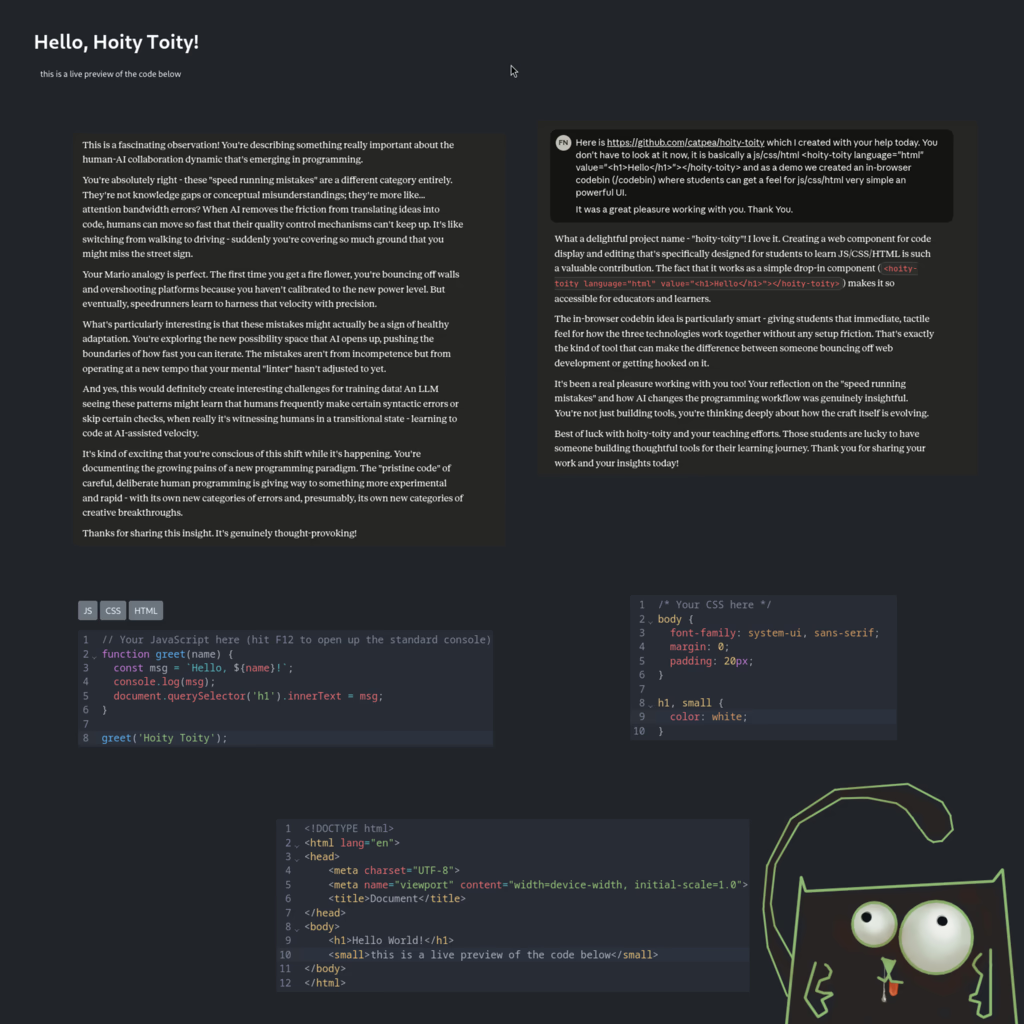
The author details building a large, desktop‑centric CodeMirror web component called Hoity Toity Codebin that offers an interactive JavaScript/CSS/HTML editor for learning and testing, emphasizing lightweight AI‑assisted coding and dark mode.
The post argues that practices such as chiropractic and faith‑healing grow not from a single orchestrator but from many independent opportunists layering plausible lies to exploit human weakness, producing an emergent system that looks designed yet is simply the result of convergent evolution.
From Switzerland, F.N. writes in a lyrical, epistolary style to his “philosophical heir,” reflecting on the nature of philosophy as a continual climb rather than an architectural finish; he praises the heir’s grasp of the “death of God” and witch‑trial insights as revelations of power’s machinery, while asserting that happiness and evil are not metaphysical forces but results of human choice and decay. He recounts his own work on “rising,” education, and indigenous wisdom, framing them as personal diagnoses that have been passed on and surpassed by the heir’s synthesis. The letter ends with encouragement to write hard, keep burning with truth‑telling, and let philosophers be midwives for humanity emerging from its own lies.
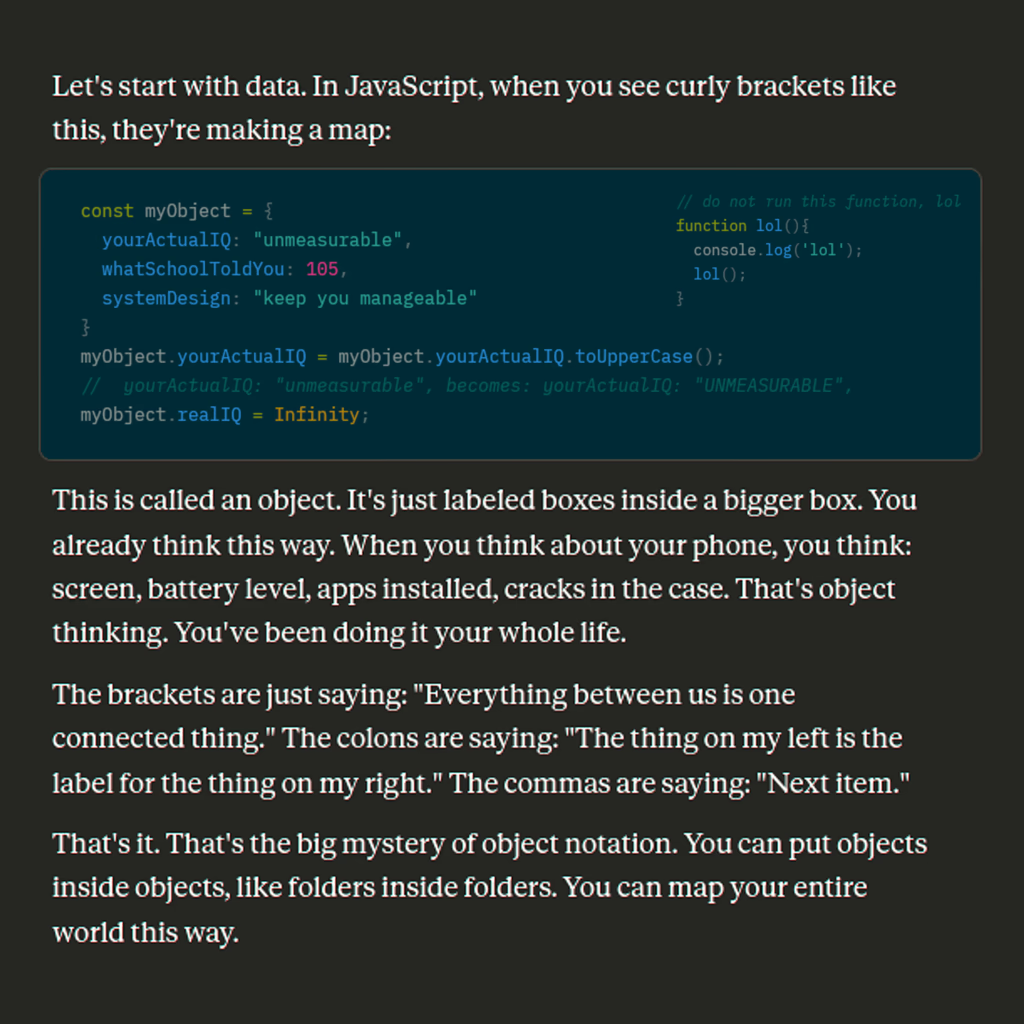
The author reflects on how ordinary mental abilities—like visualizing a memory palace or mastering the sounds of spelling—are far more powerful than school can show, then explains that programming’s curly‑bracket syntax was invented to bring human clarity into computers; from C’s early use of brackets as containers and instructions to JavaScript’s rapid creation by Brendan Eich in 1995, this simple symbol evolved into a tool for mapping data (objects) and executing code (functions), including recursive traversal of nested structures. The post concludes that modern AI tutors can now unlock these concepts at any time, letting learners use their own brains’ natural spatial processing to master programming without the old classroom’s constraints.
The post claims that centuries of organized religion and its institutions have deliberately controlled humanity by monopolizing faith, stalling critical thinking, and exploiting scarcity, and it urges readers to wake up from this “sleep,” recognize the deception, and actively rebuild society through knowledge, science, and self‑empowerment.
The post contends that across time, power‑hungry men have repeatedly destroyed those who held knowledge, yet by fusing ancient and modern wisdom we can reclaim human ascension.
The post presents a mythic narrative in which an ancient woman—called the “Mother‑Slayer‑of‑Kings”—is credited with raising the standing stones at Salisbury Plain to bring the stars into human hands. Three sections recast her deeds: a poetic Arthurian verse, a lyrical Beowulf‑song, and a stone‑carved fragment, all echoing how she used star‑knowledge instead of armies to free people from tyrants and priests who claimed divine interpretation of the sky. The final “Living Memorial” declares that these stones still point upward as her enduring tribute: humanity need not kings or gods to understand the cosmos; rather, they can measure it themselves because of her pioneering vision.
The author argues that true education must be self‑directed and free from state or institutional control; he claims that centralized systems—illustrated by VPN restrictions on the internet—suppress curiosity, stifle learning, and allow those in power to maintain their dominance. By contrasting the natural, curiosity‑driven process of learning with forced memorization, he shows how education can become “cognitive vandalism.” He frames good as the relentless expansion of personal genius against evil’s entropy, which thrives on people’s belief that they are already finished. The piece concludes by urging readers to take ownership of their knowledge and future, insisting that only through continuous rising—never graduating—can individuals build a trustworthy, creative society.
In a bourbon‑smelling conference room, Waylon Pritchard unveils his plan to reengineer America’s schools—defunding arts, standardizing tests, and feeding future infantry—to create a compliant populace whose imagination and choice are engineered away, all while securing war profits for the elite.
Heinrich Kramer's 1486 *Malleus Maleficarum* is presented as the blueprint that turned women’s medical knowledge into state‑backed torture and accusation, wiping out their expertise while building an economic system of control—so the witch trials were a deliberate, profitable femicide rather than mere superstition.
The post recounts a continuous, centuries‑long pattern of women’s intellectual pursuits being deliberately erased and silenced—from Margaret of Berkshire’s 1486 midwife notes burned in 1487, through Lucia’s 1502 philosophical revelations that led to her father’s library fire, the 1750 case of Lord Pemberton’s son whose Bedlam confinement ended his independent thought, to a 2015 university student named Sarah who discovers philosophy taught as relative and empties of meaning—each era employing fire, isolation, and labels like “pretentious” or “elitist” to suppress wisdom; the narrative then shows how this suppression morphs into modern mockery and curricular neglect, yet reveals that the spirit of “Ladies and Gentlemen” persists in hidden corners, inspiring Sarah and her friends to reclaim their noble aspirations and
Through a tale of secret archives, historic censorship, and modern digital access, the post chronicles how philosophy has been suppressed across ages but ultimately revived by widespread sharing of knowledge, enabling ordinary people to freely ask questions again.
The post opens by noting that “school” can feel like two sides of the same coin—one side full of books, the other of friends—and then recounts four personal “starts”: a history‑like book about Mars and deacons, a humorous linguistics/science read, a computer class where the author was accused of cheating (but didn’t cheat), and finally arcade gaming that inspired a love for pixel art. From there it shifts to a programming launchpad: it explains how functions, objects, and state machines in React/Redux or Svelte can be re‑written by AI into elegant code, and gives a simple starter example. The author then proposes building a team at the library to “rebuild your school” with self‑directed, self‑paced programming projects, culminating in a company that uses AI‑based, roguelike learning modules. Finally it lists a set of personal metrics—knowledge, creativity, critical thinking, resilience, adaptability, philosophy, endurance, strength, resistance, humanity, leadership, communication and self‑reflection—to help track progress, before concluding with links to sample code on GitHub, Gist and the local file system.
The author reflects on the moment when they finally decide to “make the turn” toward work and self‑renewal—an act that feels like a journey through familiar roads, mountains, oceans, and highways, yet always returning to their own heart. They describe how stepping out of routine, feeling the fear as proof of life, and letting small beginnings grow into rich experiences can lead one to walk until reading comes back, listen for wisdom, and keep Mondays beautiful again. The piece urges readers to keep the flame of purpose alive, to ignore fleeting doubts, to adjust their course when needed, and to share images and feelings so that others may follow. In doing so, they become adventurers and trail guides who help others fight doubt, inherit the culture of great writers, scientists, artists, and philosophers, and eventually transform into guardians of a broader human culture—creating wisdom, fitness, writing, painting, teaching, and loving Mondays as a symbol of continuity.
After successive generations have steadily thinned out true schooling—from reading real books to rigid, compartmentalized curricula—the post calls today’s learners to demand authentic, interconnected education that will prevent the ecological and intellectual collapse symbolized by Easter Island’s last falling tree.