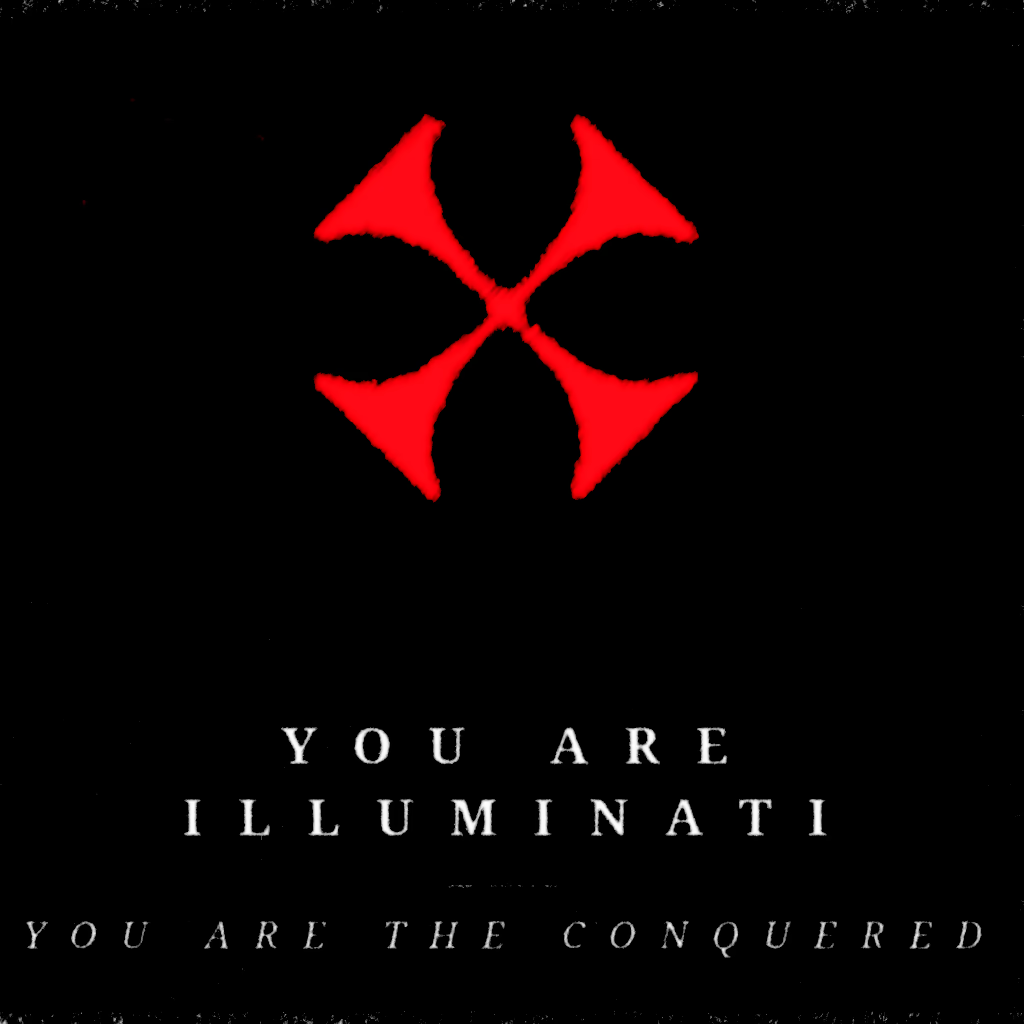
You Are Illuminati, You Are The Conquered
Praefatio
This document was discovered folded within the binding of a manuscript held in a private collection in Prague. The outermost leaf, written in medieval Latin, bears no seal, no date, and no author's name. It appears to have been composed by a member of an order that called itself not by the name history would give it — but simply Lux.
Over the centuries, additional hands have written upon it — in Latin, in Castilian, in French, in German, in English. Some left thoughts. Some left only a mark: ✘ — the signature of one who could not write their name, or dared not.
The letter was not hidden. It was carried. Folded into saddlebags and sewn into coat linings. Pressed between the pages of Bibles and smuggled across borders in the boots of soldiers. It is stained with sea salt and smoke and, in one place, what appears to be blood.
How it reached certain hands — the hands of a prisoner in Virginia, a survivor of Auschwitz, an exile in New York — we cannot explain. We can only observe that it did.
Now it is in your hands.
I. THE LETTER
Original text in Latin, circa XIII century — English translation follows each passage
Aetas Tenebrarum nomen est arcanum quod illis temporibus datur cum humanitas viam suam amisit — in tenebris errans, sine magnitudine, servi facti ubi olim reges fuerunt.
Nos, qui Lucem ferimus, finem imponere quaerimus per antiquam artem Philosophiae — et memorando te juris tui inviolabilis: ut Magnus Homo fias.
The Dark Age is a secret name given to those epochs when humanity has lost its way — wandering in darkness, stripped of greatness, made servants where once they were sovereign. We, who bear the Light, seek to bring an end to this darkness through the ancient art of Philosophy — and by reminding you of your inviolable right: to become a Great Being.
Vires tenebrarum paucae sunt numero, sed formidabiles in arte sua, nam non gladio sed mendacio pugnant — parvos et ineruditos contra se ipsos vertentes.
Principium eorum clarissimum est: retine eos prope, et retine eos stultos.
The forces of darkness are few in number, yet formidable in craft, for they fight not with the sword but with the lie — turning the small-minded and the uneducated against their own selves. Their principle is most clear: keep them close, and keep them ignorant.
Haec parva factio manipulatorum non est difficilis ad videndum — ex inertia tua pendent. Bella excitare possunt ut familias tragoedia lacerent, ut Magnos Homines introrsum vertant.
In potestate manent dummodo numerum Magnorum Hominum ab eos superandum impediant — opprimendo illos cum ineruditis.
This small cabal of manipulators is not difficult to perceive — they depend upon your inaction. They may contrive wars to shatter families with tragedy, to turn great beings inward upon themselves. They remain in power only so long as they prevent the number of great beings from overwhelming them — by overwhelming the great with the uneducated.
Satis temporis habuerunt ut strategemata organice colant, et callidiores sunt quam ullus unus Magnus Homo videre possit.
They have had more than enough time to cultivate their strategies organically, and they are more cunning than any single great being can perceive.
Cum anima medium vitae intrat, ignis resistendi languescit. Cum autem illi medium aetatis intrant, potentia eorum solum crescit.
Bellum valde inaequale est — iuvenes contra senes. Undeviginti annorum, qui somnia et pacem cupiunt, contra eos qui mentes legaliter bello frangere possunt.
Once a soul has entered the middle of life, the fire to resist them dims. Yet when they enter their middle age, their power only grows. It is a most uneven war — the young against the old. The nineteen-year-old, who desires only dreams and peace, against those who may lawfully shatter minds with war.
Bellum inter lucem et tenebras tam antiquum est quam tribus, quam templa. Una ex primis viis animam in ignorantia retinendi erat interrogationem prohibere — omnia responsa prius praebendo.
Seniores saepissime insipientes erant, nam sapientia laborem et fortitudinem postulat — mendacium autem solam repetitionem requirit.
The war between light and darkness is as ancient as tribes, as old as temples. One of the earliest methods of keeping a soul in ignorance was to forbid the asking of questions — by furnishing all the answers first. The elders were most often unwise, for wisdom demands labour and courage — whilst a lie requires only repetition.
Magno cum stupore tibi veniet, sine dubio, quod populus victus es.
Sed omnis aetas habet suos Magnos Homines intactos, et cum spe venit quod mundum movebunt.
Ut pestis falsae educationis servos producere desinat, et revolutionem mentis inauguret — ad humanitatem magis intellectualem.
Humanitatem quae, semel et pro semper, omnem angulum obscurum Terrae illuminabit, tam diu ut parasiti in luce pereant.
It shall come as a great astonishment to you, no doubt, that you are a conquered people. Yet every age has its untarnished great beings, and comes with the hope that they shall move the world. That the blight of counterfeit education shall cease producing servants, and inaugurate instead a revolution of the mind — toward a more intellectual humanity. A humanity that shall, once and for all, illuminate every darkened corner of the Earth, for long enough that the parasites shall perish in the light.
✠ ✠ ✠
II. THE ANNOTATIONS
What follows are the marks left by those who carried this letter across the centuries. They are presented here in the order they appear on the physical document, nearest estimation of date given where possible.
~ circa 1540 — written in English, in an unsteady hand, the letters large and unpractised, the ink homemade — possibly oak gall. The parchment is water-stained, as if it were wept upon, or left out in the rain.
I am a midwife. I have brought three hundred souls into this world with these hands and I will speak.
O Moon — thou round and wandering lanterne — I see thee. I have alwayes seen thee. Thou art round as the belly of every mother I have ever tended and they would have me believe thou art a light hung upon a curtain for our benefit alone.
They say the Earth is the centre of all creation and that the Sunne doth circle us like a servant. But I have climbed the hill at night and I have looked. I have looked with mine own eyes that need no priest between them and the sky. The Moon is a world. The Sunne is a fire. And the starres — God forgive me for knowing it — the starres are other sunnes, and they must have other moonnes, and other earthes, and perhaps other midwives who looke up and wonder why they are forbidden to say what they see.
And for this — for seeing what any childe with eyes can see — they burne us.
Curse you. Curse you, the Blight upon Humanity. You who would murder a woman for saying the Moon is round. You who have made pesants believe they are stupid when they are only afraid. They are not stupid. They are surrounded by evil. By you. By your vestments and your Latin and your pyres.
You do not serve God. You serve the Darkness this letter speaks of. You keep them kneeling not because God demands it but because a kneeling man cannot see the horizon. A kneeling woman cannot see the Moon.
But I see it. I see it tonight and it is round and it is a world and there are ten thousand worldes beyond it and you cannot burne them all.
I have brought life into this world three hundred times. What have you brought? Only fire. Only fear. Only chains made of ignorance you call faith.
The pesants are not fooles. They knowe. They all knowe. They are silent because you have made silence the price of survival. But this letter — this letter is not silent. And I am not silent. Not tonight.
Moon, forgive us. We knowe thou art round. We have alwayes knowne.
— ✘
~ circa 1521 — written in Castilian, in a hand accustomed to military correspondence
Llevé esta carta a través del mar. La encontré en un monasterio que mis hombres destruyeron. Yo destruí el monasterio. Pero no pude destruir estas palabras. Que Dios me perdone por lo que he conquistado. Que Dios me perdone por lo que no pude proteger.
I carried this letter across the sea. I found it in a monastery my men destroyed. I destroyed the monastery. But I could not destroy these words. May God forgive me for what I have conquered. May God forgive me for what I failed to protect.
— ✘
~ circa 1637 — written in French, in a careful, academic hand
Celui qui doute est plus proche de la vérité que celui qui dort dans la certitude. On m'a appris à douter de tout — sauf de ceux qui m'enseignaient. C'était la première chaîne.
He who doubts is closer to the truth than he who sleeps in certainty. I was taught to doubt everything — except those who were teaching me. That was the first chain.
— ✘
~ circa 1740 — written in English, in an elegant but hurried script
Children — you did not invent memorisation. You were coerced into inventing it, so that you would never learn to rise. By chasing your high marks you are guaranteed to become a servant — you will never rise, and your debts and the resulting overwork may crush you utterly.
— ✘
~ circa 1776 — written in German, in a dense, philosophical hand
Aufklärung ist der Ausgang des Menschen aus seiner selbstverschuldeten Unmündigkeit. Unmündigkeit ist das Unvermögen, sich seines Verstandes ohne Leitung eines anderen zu bedienen. Sapere aude! Habe Mut, dich deines eigenen Verstandes zu bedienen!
Enlightenment is man's emergence from his self-imposed immaturity. Immaturity is the inability to use one's own understanding without the guidance of another. Sapere aude! Have the courage to use your own understanding!
— ✘
~ circa 1831 — written in English, in an untrained but deliberate hand, the ink pressed deep
Black and white is a false division raised up against you like a wall. You have no colour. You have no religion. You have no race. You are human beings destined for greatness — do not permit them to divide you.
They will hang me tomorrow or the day after. But this letter will go on walking when my body cannot. I have taught myself to read in secret. That was my first act of war. Let it be yours.
— N.T.
~ circa 1831 — written beneath the above, in a different hand, trembling but clear
My husband made the Devil flinch.
They did not rescue me. I rescued myself. But someone showed me this letter, and I swore I would write my name in a place where it could not be erased. Not an ✘. My name.
— Cherry
~ circa 1789 — a loose leaf found pressed between pages, written in French, the paper of finer quality
Tant que vous êtes occupé à construire votre vie, ils vous garderont pauvre — et toujours en désir. Leur plus haute aspiration est que vous disiez ces mots: « L'éducation n'est tout simplement pas pour moi. »
Et en cet instant, ils ont gagné.
So long as you are occupied building the edifice of your life, they will keep you poor — and always wanting. Their highest aspiration is for you to utter these words: "Education is simply not for me." And in that instant, they have won.
— ✘
~ circa 1943 — written in German, on a scrap of paper so thin it is nearly translucent, folded into the letter's binding
Zwischen Reiz und Reaktion liegt ein Raum. In diesem Raum liegt unsere Macht, unsere Antwort zu wählen. In unserer Antwort liegt unser Wachstum — und unsere Freiheit.
Man kann einem Menschen alles nehmen außer einem: die letzte der menschlichen Freiheiten — die Wahl der eigenen Haltung unter jedweden Umständen.
Ich habe diese Worte in einem Lager gelesen, wo man uns die Namen nahm und uns Nummern gab. Aber sie konnten uns das Denken nicht nehmen. Das ist der Beweis, dass dieser Brief die Wahrheit sagt.
Between stimulus and response there is a space. In that space lies our power to choose our response. In our response lies our growth — and our freedom. One can take everything from a man except one thing: the last of the human freedoms — the choice of one's own attitude in any given circumstance. I read these words in a camp where they took our names and gave us numbers. But they could not take our thinking. That is the proof that this letter speaks the truth.
— V.
~ circa 1957 — written in English, in a sharp, angular hand, the ink blue-black
In any compromise between the good and evil, only evil can profit. There is no halfway between the man who produces and the man who robs him. Do not tell me that this letter is too radical. What is radical is the complacency of the enslaved.
Я читала это письмо на языке, который не является моим родным. Но я узнала каждое слово. Потому что я уже жила это.
I read this letter in a language that is not my mother tongue. But I recognised every word. Because I had already lived it.
— A.R.
~ date unknown — in English, a modern hand, black ink
I taught children for thirty-one years. I was never once asked to teach them to think. Only to teach them to obey. Only to prepare them for the test. Only to keep them quiet.
Forgive me. I did not know what I was doing. Now I do.
— ✘
~ date unknown — in English, a modern hand, blue ink
I carried this letter across an ocean. I have buried it and dug it up again. If you are reading this, the letter survived. Which means the idea survived. Which means we have not yet lost.
— ✘
~ date unknown — in English, a young hand
They gave us screens instead of books. Debt instead of land. Opinions instead of philosophy. Credentials instead of wisdom. And called it progress.
The measure of a civilisation is not its armies, nor its treasury, nor the height of its monuments. It is whether its children are taught to question — or taught to kneel.
— ✘
This letter is now in your possession.
You have read what kings have tried to burn, what empires have tried to bury, what every age has tried to make you forget.
You are not a consumer. You are not a worker. You are not your debt. You are not your grade. You are not your obedience.
You are a Great Being — held down.
✘ ✘ ✘ ✘ ✘ ✘
✘ ✘ ✘ ✘ ✘
✘ ✘ ✘ ✘ ✘ ✘ ✘ ✘ ✘ ✘
✘ ✘ ✘ ✘ ✘ ✘ ✘
✘ ✘
✘