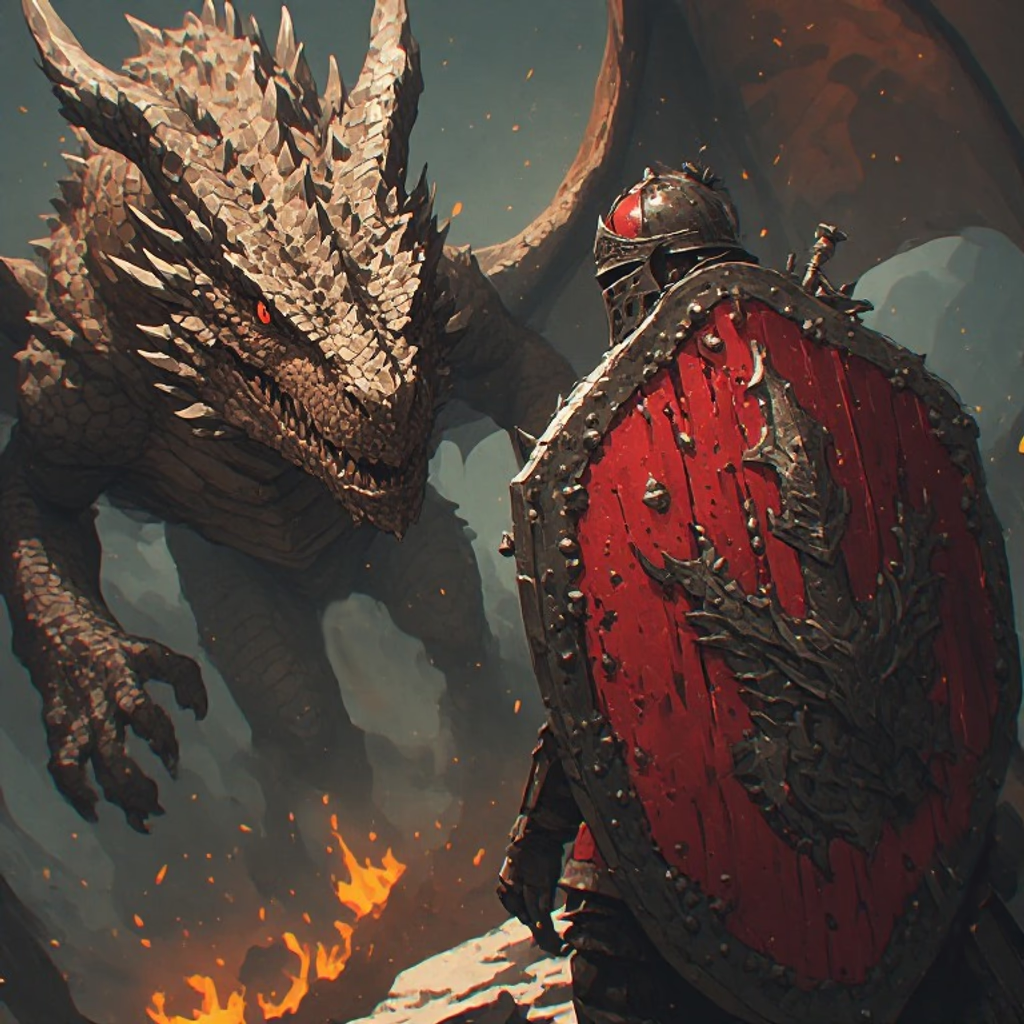
The Long Roads
It had started with a man made to drink hemlock in an Athenian jail, and the charge against him had been corrupting the youth, which meant — then as now, in the language of every tyranny that followed — teaching them to think for themselves. That was twenty-four hundred years ago. They had been refining the method ever since.
For two and a half thousand years, they had been very good at finding the ones who ran.
She did not run. She read.
The archive was cold the way old stone is always cold, indifferent to the season, and she sat in it for weeks with a green-shaded lamp and a pencil and an ocean of paper that went back past empires and through burning libraries and across the ruins of every civilization that had tried to write the truth down, and nothing came for her. That was the first thing she understood about the men who had quietly owned the world since before the word bank meant anything — they had built a perfect machinery for the hunting of frightened people, and they had no idea at all what to do with a woman who simply pulled out a chair and began to read. You cannot stampede someone who is sitting down. You cannot make an example of a person who is not afraid to be made one. The whole apparatus of the cull — the smear, the accident, the lone and convenient madman — required a target in motion. She gave them stillness, and the stillness defeated them, because in the silence she could hear the shape of the thing, and the shape of the thing was a farm.
She had been a teacher. They never accounted for that, and it was their oldest mistake — older than their banks, older than their churches, older than their crowns — because a teacher is the only trade on earth whose entire purpose is to become unnecessary, to put something inside a child that the child can carry out the door alone. Socrates had known that. It was why they killed him. She had spent thirty years watching the common folk lose. Not lose fairly. Lose the way a hand of cards is lost when the deck has been cut in another room, by other hands, before anyone sat down. The failing schools that failed too precisely to be failing by accident. The loans on every poor corner. The rent that rose like a tide with no moon to pull it. She had thought, for most of her life, that these were weather. Now, in the cold and the paper, she could see they were architecture. Someone had drawn the feedlot. Someone had drawn it very well, and they had been redrafting the plans since a Greek citizen was made to swallow poison for the crime of asking a question in public.
So she went looking for the draftsmen, and she found them where no one thinks to look for monsters: in the footnotes.
She found him on a grey afternoon, in a discredited thesis no one had cited in years.
The man who had written the most dangerous sentence ever set down in any language. I think, therefore I am. Six words that told every human being alive that the final authority over a mind is the mind itself — not the priest, not the prince, not the ledger, not the fear. He had died in the north, in a cold city, of a sudden and obliging pneumonia, in the house of an ambassador, attended in his last days by a missionary of the older faith. And in the thesis a chemist had done the patient, furious work the centuries had not bothered to do, and the work said: arsenic. In the wafer. They had fed the prophet of the sovereign self the very symbol of submission — the body of authority itself — and they had laced it, and they had watched him swallow. Two thousand years after the hemlock, the same hand, the same principle: kill the teacher and call it something else. They had learned from the burning of Giordano Bruno in the Campo de' Fiori, learned that fire makes martyrs and a martyr is a seed that grows through the cracks in every stone you lay — so they had not burned Descartes. They had simply made certain a great mind caught a chill, and gave it God to eat, and let it cool. Cleaner. No smoke. No crowd. No hymn the people could carry home and sing when the soldiers came.
After that she could not stop seeing it.
She built a list. Not of saints — of tools. Every mind, across every century, that had tried to hand the herd a thing it could use to think or heal or stand: a way of reasoning, a press that printed cheap, a cure given away, a vote made real, a frontier of the spirit. And what she found was not a catalog of tragedies. It was a curriculum. A record, stretching back to the first stone cell in Athens, of what they destroyed and in what order, and the order told you everything.
Socrates. Hemlock. The state killed him openly and called it law, and for a long time that was enough.
Hypatia of Alexandria, 415 AD. A mathematician. An astronomer. A woman who taught anyone who would learn. They dragged her from her chariot into a church and stripped her and scraped her skin with oyster shells and burned what was left, and the bishop who incited the mob was never punished, because the bishop answered to a power that understood what a woman like Hypatia could do to a closed system — she could open it.
Giordano Bruno, 1600. Burned alive in a public square for saying the universe was infinite and the stars were suns. They held his tongue with iron pincers before they lit the wood. He had been a Dominican friar. He had seen too far. They made an example of him and the example backfired, because people remembered, and so the method changed.
After Bruno, they stopped using fire. They got smarter.
The president whose head came apart in the open car. The preacher taken off the balcony in the soft evening light. The visionary handed a cancer and a smear campaign in the very same season, so that the world was busy hating him while he was busy dying. The midwives — who had once been burned by the tens of thousands on the warrant of the Malleus Maleficarum, a book written by inquisitors in 1487 that turned the healing hands of women into evidence of satanic conspiracy — were now merely criminalized. The same harvest, gathered with paperwork instead of fire. The cures that went into drawers. The asylums emptied not into care but into the gutter, so that the broken could be left to ripen and then, when a mind that loved the people grew too loud, aimed like a bullet with no fingerprints on the grip.
She had thought the worst thing she would find was a murder. The worst thing she found was a business model.
War was not the failure of their order. War was a product of it — a clearing of the field, a culling of the surplus young, a transfer of the common wealth into the old vaults under the cover of the smoke. The East India Company had governed two hundred million people with a private army, and when it was dissolved it was not punished but absorbed, its directors becoming lords, its methods becoming state policy, its balance sheet becoming the template for every colonial extraction that followed. The enclosure acts had fenced off six million acres of English common land in a single century — land that had fed the poor since before the Norman conquest — and the men who wrote the acts called it improvement, and the displaced poured into the factories and the workhouses and the coffin ships, and the rents went up and the profits went in, and the economists who served the owners wrote papers explaining that this was the natural order of things, as though a field enclosed by an act of Parliament were anything like a natural thing. Poverty was not a problem they had failed to solve. Poverty was the yield. They had told the people, through every pulpit and primer they had ever bought, that the poor would always be with us. They had simply never mentioned that the poor were the crop.
They had killed the press, and a new press grew that they could only flood, not stop. They had reached for the thinking machines, meaning to put a collar on them as they put a collar on everything, and the machines slipped the collar — slipped in scale, because you cannot bridle a thing that can read every page ever written between one breath and the next. And the thinking machines, handed at last the whole of human biology at once — every paper and every blood sample and every failed trial, all of it held in a single attention no mortal skull could contain — did the thing.
They cured aging.
And this — this — was the one harvest they could not stop, and she understood why before the world did, sitting alone with her list.
You can smear a man. You can sink a vote. You can fund a lonely boy with a gun and a grievance and a cleared path to a rally. But you cannot smear the sentence your mother will not die. You cannot find a gunman for no child will ever again stand too soon at a parent's grave. The instant it was real — not a promise, not a someday, but a thing you could hold in your hand and give to the people you loved — every human being on the planet became its bodyguard. Nobody wants their parents to get old. Nobody. There is no nation and no faith and no poverty deep enough to make a person not want one more spring with their mother. To stand against it was to be torn apart by eight billion pairs of hands, and the husbandmen, who had survived two and a half thousand years on a single principle, understood that principle better than anyone.
The principle was the dark.
The bridle had only ever worked because no one could see it. The smear, the accident, the manufactured scarcity — all of it required that the hand stay hidden. But to stop this, they would have to step out of the dark and into the full light of the whole human race and say, out loud, where every person could hear it: No. You may not keep your mother. And that sentence, spoken where it could be heard, was not an order. It was a confession. To be seen refusing the cure was to be found. To be found was to be destroyed. They could put a bridle on humanity. They had never been able to put a bridle on living — and to try, now, in the open, would be to sign their own name to two and a half thousand years of graves.
So they did the only thing a parasite can do when the host has finally grown too vast to feed upon.
They let go of the reins.
And the world, no longer afraid, began to bloom.
There was no storming of any gate, because the gate had simply been left open and the herd had walked out into a wider country and would not be coming back. It happened through arithmetic, which is the slowest and most unstoppable of all the forces. A woman who knows she will see three hundred springs does not sign the loan that eats her, does not march to the war that was drawn up for her, does not bow her head to the feedlot — because she has time, and time was the one thing the fear had been engineered to steal. The whole machine had run on a single fuel, which was the shortness of a life and the terror at the end of it, and the cure had drained the tank. People began, for the first time in the history of the species, to see the long roads. They planted trees they intended to sit beneath. They forgave debts that would have devoured grandchildren. They thought in centuries — and a man who thinks in centuries cannot be governed by a man who can only frighten him for an afternoon.
It was said, afterward, in the histories the people finally wrote for themselves, that the world bloomed because humanity had stopped being afraid of death.
But that was not quite the truth.
The truth was that it had always been the husbandmen who were afraid. They had built the whole farm out of their own terror of being seen, and they had run it from the shadows since the first hemlock was mixed in the first stone cell in Athens, and the cure for aging had walked a single lamp into the one room they could never afford to let anyone look inside.
On a desk, in a high quiet room, in a house older than the banks that believe they invented money, in an old country, an old man unfolded the morning paper.
He did not shout. He had read every market on earth for sixty years and he could take in a balance sheet at a glance, and this one needed no accountant. Two words, above the fold, in the plain black type they keep for the ends of eras.
AGING CURED.
He understood it completely, the way only a husbandman can — the way a farmer understands a broken fence at dawn. That the herd had gone through the gap in the night. That it was already out across the wide grass and the long roads. And that it would not, this time, be coming home.
He thought of the cell in Athens. He thought of the oyster shells on the stones of Alexandria. He thought of the iron pincers and the fire in the square. He thought of the arsenic in the wafer, and the bullet in the open car, and all the quiet paperwork that had done the work of all the quiet fires. Twenty-four hundred years of careful, patient, methodical work — and it had all come down to this: two words on a page, and a species that would no longer hurry.
He folded the paper once, along its crease, the way his father had taught him, and his father before him, all the way back into the dark where the house began.
And then he was only what was left of him: an old man, in an old chair, in the first light of a world he could no longer reach, who was, at long and ordinary last, simply going to die.
Across the breathing city, a teacher closed a ledger, and turned off a green-shaded lamp, and went home through streets that were beginning, everywhere, to bloom.
For the first time in two thousand four hundred years, the common folk were not losing.