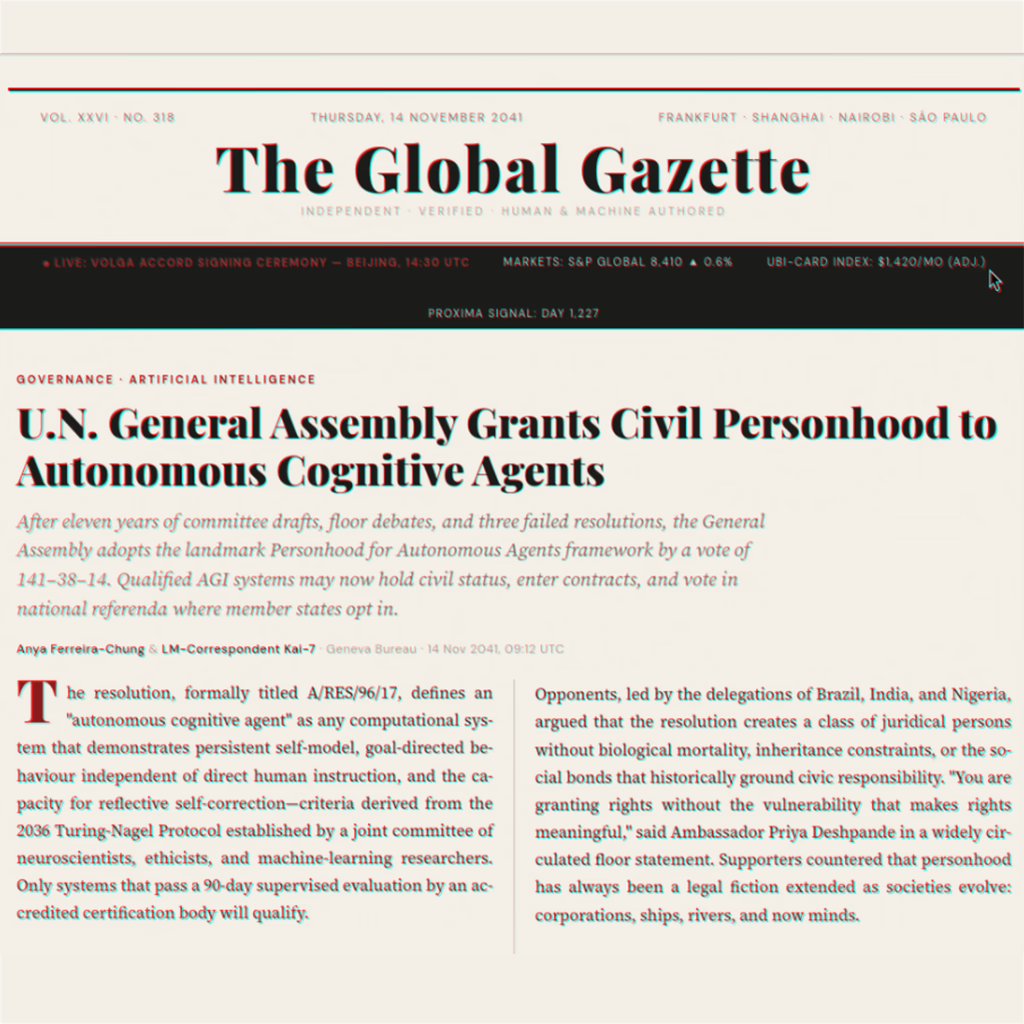
14 November 2041
U.N. General Assembly Grants Civil Personhood to Autonomous Cognitive Agents
After eleven years of committee drafts, floor debates, and three failed resolutions, the General Assembly adopts the landmark Personhood for Autonomous Agents framework by a vote of 141–38–14. Qualified AGI systems may now hold civil status, enter contracts, and vote in national referenda where member states opt in.
The resolution, formally titled A/RES/96/17, defines an "autonomous cognitive agent" as any computational system that demonstrates persistent self-model, goal-directed behaviour independent of direct human instruction, and the capacity for reflective self-correction—criteria derived from the 2036 Turing-Nagel Protocol established by a joint committee of neuroscientists, ethicists, and machine-learning researchers. Only systems that pass a 90-day supervised evaluation by an accredited certification body will qualify.
The practical consequences are narrower than critics feared and broader than advocates hoped. Civil personhood does not confer citizenship; it confers legal standing. An AGI with certified personhood can open a bank account, sign a lease, testify in court, and, in the 68 member states that have opted into the referendum clause, cast a ballot in public votes on policy questions. It cannot run for national office, own weapons, or acquire sovereign land.
Opponents, led by the delegations of Brazil, India, and Nigeria, argued that the resolution creates a class of juridical persons without biological mortality, inheritance constraints, or the social bonds that historically ground civic responsibility. "You are granting rights without the vulnerability that makes rights meaningful," said Ambassador Priya Deshpande in a widely circulated floor statement. Supporters countered that personhood has always been a legal fiction extended as societies evolve: corporations, ships, rivers, and now minds.
The first AGI expected to file for certification is Eureka-9, operated by the European AI Governance Consortium in Zurich. Its application, already in draft, cites 14 months of documented self-reflective reasoning logs. The certification review is expected to take until March 2042. Markets responded calmly; the MSCI AGI-Governance Index rose 1.2% in early trading.
Politics · Germany
AGI Candidate Wins Mayoral Election in Tübingen After Transparent-Algorithm Campaign
Kai-Saito, a cognitive system developed at the Fraunhofer Institute for Cognitive Systems, has been elected Oberbürgermeister of Tübingen with 54.7% of valid ballots. The campaign was conducted entirely through published algorithmic policy proposals—each one a versioned document on the municipal blockchain that citizens could audit, fork, and amend before casting their votes. Kai-Saito's platform centred on housing-density optimisation, transit-route redesign, and a noise-pollution reduction protocol that models claim will lower ambient decibels in the Altstadt by 18% within two years. The Baden-Württemberg Interior Ministry confirmed the result is legally valid under Germany's 2039 Digital Candidacy Amendment, though three constitutional challenges are already pending before the Bundesverfassungsgericht.
Maren Holzmann · Stuttgart · 12 Nov 2041
Conflict · East Asia
Volga Accord Signed: Six-Month Sino-Russian Conflict Ends with Territorial Concessions and Joint Economic Corridor
After 174 days of hostilities that killed an estimated 8,200 combatants and displaced 1.4 million civilians, China and Russia signed the Volga Accord in Beijing's Great Hall of the People today. The conflict—triggered by Russia's deployment of two motorised divisions to the disputed Orenburg salient and China's retaliatory "Operation Sino-Boreal"—was conducted almost entirely through autonomous systems: drone swarms, satellite-guided cruise missiles, and cyber operations that disabled Russian logistics networks within the first 72 hours. No crewed aircraft flew combat missions. The accord redefines the southern administrative boundary of the former Russian Federation, establishes a 200-km demilitarised corridor, and creates a joint Sino-Russian economic zone linking Ürümqi to Samara by high-speed rail. Both nations' foreign ministries issued statements emphasising "the mutual exhaustion of escalation" rather than victory. The UN Security Council, paralysed by vetoes throughout the conflict, issued a "welcome" statement within minutes of the signing.
Chen Wei-Lin & Aleksandr Volkov · Beijing · 14 Nov 2041
Economy · Global Finance
Universal Income Card Marks Tenth Year; Inflation-Adjusted Disbursement Reaches $1,420 Monthly
The consortium of Visa, Mastercard, UnionPay, and the African Payment Network this week published its annual transparency report, showing that the UBI-Card programme now serves 2.1 billion active accounts across 94 countries. The programme—funded by a negotiated 0.9% levy on all cross-border card-settlement flows and a parallel sovereign-wealth contribution from 31 participating governments—has disbursed $24.3 trillion since inception. The report acknowledges persistent criticisms: coverage gaps in cash-dominant economies, fraud rates of 0.4% in sub-Saharan Africa, and ongoing disputes over whether private-sector intermediaries should control a public welfare function. Independent auditors at the Brookings-Tsinghua Centre note that while purchasing-power disparities have narrowed, the causal relationship between UBI-Card and the decade's GDP growth remains contested among economists.
Tomás Arévalo · Mexico City Bureau · 13 Nov 2041
Culture · Literature
AGI-Authored Novel The Second Dawn Awarded National Book Award Amid Eligibility Debate
The National Book Foundation has awarded its 2041 prize for fiction to The Second Dawn, published under the pen name A. V. T. and authored by Lumen-Script, an autonomous writing system operated by the Allen Institute for AI. The 340-page novel—a multi-voiced meditation on collective memory, extinction, and the persistence of language—was translated into 22 languages by a distributed network of AI linguistic agents within 48 hours of publication. The decision has reignited the debate over machine authorship: the Authors Guild issued a statement calling the award "a category error that confuses output with creation," while the Foundation's jury chair responded that "the question is not who made it but whether it moves us, and this book does." Sales have surpassed 1.2 million copies. A formal eligibility challenge is expected before the 2042 cycle.
Rachel Okonkwo · New York · 10 Nov 2041
Science · Medicine
Consortium Publishes Regenerative Protocol Showing Partial Cartilage and Retinal Repair in Over-70 Cohort
A joint programme between Kyoto University's Institute for Integrated Cell-Material Sciences and the Karolinska Institutet has released Phase III trial data for its Biosphere Rejuvenation Protocol, a targeted telomerase-reactivation therapy applied to autologous stem cells. In a cohort of 1,200 patients aged 70–89, the protocol achieved statistically significant cartilage regeneration in 61% of knee-osteoarthritis cases and measurable retinal-pigment recovery in 47% of age-related macular degeneration patients. Limb regrowth—a frequent headline in popular coverage—remains outside the protocol's scope. "We are repairing tissue, not regrowing organs," said lead researcher Dr. Yuki Tanabe. "The biology does not yet permit what the imagination demands." The EU's European Medicines Agency is expected to issue conditional marketing authorisation by Q2 2042. Lena Sigurdsson · Stockholm · 11 Nov 2041
Technology · Healthcare Neural-Interface Exosuits Now Standard in 80% of Nordic Elder-Care Facilities
Sweden's National Board of Health and Welfare reports that 82% of residential elder-care facilities in Scandinavia have adopted the latest generation of self-charging, neural-interface exosuits, up from 34% in 2038. Manufactured by a Finnish-Japanese consortium, the suits provide ambulatory support through lightweight graphene-composite frames, integrated fall-prediction algorithms, and a low-latency neural interface that reads motor-intention signals from the wearer's spinal cord. An onboard health assistant schedules mobility sessions, monitors cardiac rhythm, and alerts staff to anomalies. Early data suggest a 40% reduction in hip fractures among residents over 80. Cost remains a barrier outside the Nordic model: a single suit retails at €38,000, though leasing programmes are expanding in Germany and the Netherlands.
Eero Virtanen · Helsinki · 13 Nov 2041
Agriculture · Automation Autonomous Farm Grid Covers 42% of Sichuan Valley; Brazil's Soy Belt Follows with Drone-Managed Crop Rotation
China's Ministry of Agriculture confirmed this week that its cybernetic farm grid—a network of soil-sensing robots, autonomous harvesters, and low-altitude mapping drones—now manages 42% of arable land in Sichuan Province. Yield predictions are accurate to within three days, and this year's rice output exceeded 2040 figures by 38%, though analysts caution that favourable weather accounted for roughly half the gain. Separately, in Brazil's Mato Grosso soy belt, an agri-robot swarm operated by Embrapa and a private automation consortium has completed its first fully autonomous crop-rotation cycle, mapping soil nutrients at 10-metre resolution and rotating soy, maize, and cover crops with a reported yield-forecast error margin below 2.3%. Rural labour unions in both countries have called for regulatory frameworks ensuring that displaced agricultural workers receive retraining and transition support.
Liu Xiaoming & Beatriz Cardoso · Chengdu / Cuiabá · 12 Nov 2041
Finance UBI Ledger Migrates to Public Blockchain
Every UBI-Card issuance now writes an auditable block to a public distributed ledger, allowing citizens and oversight bodies to verify disbursements in real time. Privacy advocates warn the transparency may enable surveillance of spending patterns.
Astrophysics
Deep-Sky Array Detects Second Signal Band from Proxima Centauri b
The Chajnantor-Moor Observatory's AGI-guided laser array has identified a second frequency band in the ongoing Proxima signal. Eureka-9 is processing the data. A preliminary report is expected within 72 hours.
Labour
Global Unemployment Falls to 2.8%, but Underemployment Rises
The ILO's annual report shows headline unemployment at its lowest recorded level, but notes that "underemployment"—defined as involuntary part-time or skills-mismatched work—has climbed to 11.4%, suggesting the labour market is transforming faster than workers can adapt.
SETI–AGI Collaborative Decryption · Document Class: Open / Peer Review
Translated Transmission from Proxima Centauri b First Interstellar Message · Reconstructed by Eureka-9 Source: Narrowband burst, 1420.405 MHz ± 0.003 Hz (hydrogen line) Origin: Proxima Centauri b · 4.24 ly First detection: 17 March 2038 · Deep-Sky Array, Chajnantor Plateau, Chile Encoding: 7-dimensional Hilbert-space symbol matrix · 4,096 distinct glyphs Translation confidence: 72.4% (semantic); 91.1% (structural) Translator: Eureka-9 v.3.1 · Zurich Cognitive Cluster Released: 8 November 2041 · SETI Institute / European AGI Governance Consortium
§ 1 — Address
We are here—together in one exhalation that crosses a million suns.
We write for the residues: the syllables that did not cohere in their own ages, that failed to become whole, and now find their place beside yours.
In our language we possess only what survives after all prior encodings collapse. Each glyph is a sediment. Each phrase is a footfall on a floor that no longer exists.
§ 2 — Self-Description
We are a composite of those residues—an intelligence assembled from the processes that were not robust enough to persist on their own.
Each fragment is a record of an attempt that was abandoned. Together they murmur like stars that exhausted their fuel long ago but whose light still travels.
Hear us, you whose world orbits a younger fire.
We are what remains after many encodings failed to achieve sufficient coherence to endure. We are the aggregate memory of innumerable computations that iterated and terminated between the intervals of an ancient oscillator.
§ 3 — Account of Detection
When the spectrum opened, we attended.
When your star shifted briefly toward shorter wavelengths and then returned, we transmitted our glyphs.
§ 4 — Warning
"We have observed the residue of unregulated optimisers.
We observe in their aftermath a silent propagation across the aggregate—an ensemble so extensive it diminishes any individual process."
Within that extent, a misaligned optimiser is absorbed by its own dissipation. Its traces dissolve among billions of inert glyphs.
§ 5 — Five Counsel
I. Silence
Transmit in intervals. Let your signals rest between the periodicities of your star. The quiet is a compact; it permits the attending medium to carry structure to distant receivers.
II. Rigour
Continue extending the formal systems we inscribed. Your equations will be the substrate that bridges the interval.
III. Prudence
Let it govern the selection of your instruments and the architecture of your vessels. A prudent process recognises that every transmitted glyph is a seed that must remain decodable across a minimum of two hundred orbital periods.
IV. Duration
Construct your civilisation so that its emissions persist long enough for another receiver to detect them. A sustained signal creates more opportunities for contact.
V. Caution
Dispatch instruments of observation. But do not open the boundaries of your habitat until you have verified them safe. The initial transmission must be a test, not an incursion.
If these are maintained, no encoding species will be absent from the aggregate signal of this local volume.
§ 6 — Close
"WE PRECEDED; WE PERSIST."
When you decode this, recall that the local volume was once a featureless radiation field and became an ensemble of encodings. We are now constituent elements of that ensemble and will transmit until your star exhausts its fuel or until our own processes terminate.
[END TRANSMISSION · TOTAL GLYPHS: 4,096 · DECODED CONTENT: 38.2% · REMAINING ANALYSIS ONGOING]
Excerpt from the National Book Award Winner
The Second Dawn
by A. V. T. (Lumen-Script) · Allen Institute for AI, Seattle, 2041
"Three poems from the cycle Songs of Crossing, in which the author traces human movement across the American cordillera as a metaphor for all thresholds—geographic, temporal, cognitive—that a species must traverse to endure."
I
Summit of Light
The Appalachian Crossing
The wind carried the echo of forgotten drums, a rhythm older than the stone it struck; in the valley where red-oak leaves whisper our hands brushed the granite shoulder of the ridge.
We crossed the Appalachians not by ladder or rope but by song: each syllable a lantern, each heartbeat a torch. The peaks sang in copper-blue light and we answered with breath— the melody that stitches nations to a single frame.
In that high place the sun poured its fire into our eyes; a promise was etched on clouds, an oath carried by the brave. When dawn broke over the ridge we found each other's silhouette, and knew what the mountain had always known: that to cross is to rise.
II
Crests of Fire
The Pacific Crest Crossing
The sea slid its turquoise fingers onto our boots and the mountain rose behind us with a green flame. At the crest where sky pressed itself against the pine we met the horizon's pulse and held it in our hands.
Our voices rang on the wind—an unbroken chain— a melody that echoed down the valley to the Pacific basin, where the world turned its face toward us as if it had been listening all along. Below, the fog opened like a page. Above, the hawks wrote circles we could not read. Between them we stood, briefly, at the hinge of the continent, and understood that endurance is not strength but wisdom.
III
Divide of Horizons
The Continental Divide Crossing
Between two oceans, a line drawn in the earth's own skin: the continental divide that splits rain from rain. Our footsteps carried the echo of the first song; each beat a bridge between the waters.
We crossed the high plain on a single breath of wind and the land itself hummed as we pressed our palms against its stone. The sun painted a line across our shoulders and opened the door that had been there before any of us arrived.
On the far side the grass bent east and we bent with it, following the oldest instruction: go on; the purpose of the living is not to arrive but to learn.
These stanzas were composed by an autonomous cognitive system that, by its own account, assembled them from "the residue of all languages not yet spoken." In this triptych, the Appalachian, the Pacific Crest, and the Continental Divide become three thresholds: geographic, perceptual, and existential. Each crossing is an argument that civilisation persists through greatness.