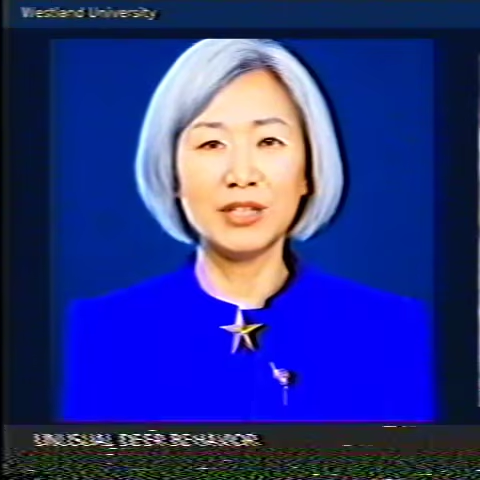
Eye Contact
Good evening.
We are interrupting our scheduled programming with an advisory concerning unusual deer behavior in several Michigan communities.
Similar reports are being investigated in Wisconsin, southern Ontario, and parts of England.
There have been no confirmed attacks associated with these incidents. Residents are not being asked to remove animals from their properties, and wildlife officials are specifically discouraging attempts to capture or harm them.
However, the guidance issued this evening includes a precaution we want to read in full.
“If a deer maintains sustained attention toward you after you have stopped moving, do not approach it or attempt to test its behavior. Return to your home, close the door, and move away from uncovered windows.”
Officials acknowledge that this describes an encounter many people would ordinarily dismiss.
What has changed, they say, is what happens when people remain outside.
[The photograph is replaced by daylight footage from a doorbell camera. A deer stands at the far end of a driveway.]
This recording was made yesterday morning in southeastern Michigan.
The animal remained near the property for approximately forty minutes. During that time, it ignored passing vehicles, a delivery driver, and two people walking a dog.
Its attention remained directed toward one resident.
When that resident moved behind a parked vehicle, the animal repositioned itself to see him. When he went indoors, it moved along the side of the house.
Those observations, by themselves, would not establish unusual intelligence.
Investigators became interested in the final portion of the recording.
The resident’s wife came outside and told the animal that her husband was working and would not be coming back.
The deer looked toward an upstairs window.
She then said, “No. The other room.”
The animal moved to the next window.
[The footage continues. The anchor allows it to run for several seconds.]
We have reviewed the original recording, including the minutes before and after that exchange.
The family says neither animal feeding nor training has taken place at the property.
We cannot independently establish what the deer understood.
But researchers investigating similar encounters say the sequence is consistent with behavior they have now reproduced under controlled conditions.
In those trials, certain animals have responded to unfamiliar instructions involving quantities, sequences, and the relative positions of objects.
They have distinguished between an instruction and its correction.
In one recorded session, an animal selected the wrong object, stopped when a researcher began to explain the mistake, and completed the corrected task before the explanation was finished.
The research group describes some of these performances as comparable to human comprehension on the specific tasks being tested.
It is not claiming that deer, as a species, have acquired human intelligence.
In fact, the animals’ ability to perform these tasks appears to end abruptly.
Sometimes in the middle of a successful trial.
A deer that has spent several minutes following complex instructions will lower its head, resume feeding, and show no further interest in the experiment.
The same animal may fail a much simpler task an hour later.
One researcher described the change this way:
“It does not look as though the animal has forgotten how to answer. It looks as though the person answering has stepped away.”
[ON SCREEN: NEUROLOGICAL FINDINGS UNDER REVIEW]
Preliminary examinations have found no unusual enlargement or structural alteration of the animals’ brains.
What researchers have identified is a second, highly regular rhythm within activity associated with sensory attention.
The animal’s ordinary neurological activity continues alongside it.
The second pattern appears during the periods of unusual responsiveness and subsides when those periods end.
A closely matching pattern has now been recorded in unrelated animals at separate facilities.
The team is investigating whether some feature of deer sensory processing allows that pattern to remain stable without disrupting feeding, movement, or ordinary awareness.
That explanation remains speculative.
The source of the pattern is unknown.
There is no identified implant.
There is also, according to the researchers, no clear reason to assume the apparent intelligence is being generated entirely within the animal.
Dr. Helen Voss, who is coordinating the neurological work, told us:
“We may be measuring information passing through a brain, rather than an ability belonging to that brain.”
Asked whether she was describing something comparable to a remotely operated camera, Dr. Voss said that was an imperfect analogy.
Then she added:
“The deer is still having its own morning.”
[The anchor briefly looks down at her notes.]
A separate line of inquiry has taken investigators to archives in Nottinghamshire.
Historians there have been asked to examine accounts of woodland guardians, unusually attentive stags, and encounters later associated with the figure of Herne.
Some of the material claims to preserve much older traditions involving woodland priests or druids. The historians involved caution that those attributions are uncertain.
These accounts are not being treated as scientific evidence.
Nevertheless, several contain a detail the researchers consider worth examining.
The animal does not speak.
It does not transform.
It waits for a particular person to realize that it is listening.
In one account under review, the encounter ends when the person addresses the animal as a beast.
It resumes when he asks who is watching.
The archive team has been asked to prioritize material that has never been published online.
That request relates to the next development in this story.
[ON SCREEN: COMMUNICATION CLAIM BEING EXAMINED]
Last week, researchers began using an experimental system built around a multimodal language model to compare the animals’ movements and faint throat vibrations with events occurring during the trials.
Initially, the system was used to identify repeated patterns.
Objects were presented. Their positions were changed. Simple questions were asked and repeated.
The researchers were not asking the software to invent a meaning for an unfamiliar signal. They were attempting to establish a small vocabulary that could be tested.
According to the team, something then began correcting that vocabulary.
A pattern assigned the meaning “food” was repeatedly rejected.
After further tests, the system revised the meaning to “something wanted.”
Other corrections followed.
The resulting exchanges became more complex.
Researchers initially suspected that the language model was producing convincing but unsupported interpretations. They say they did not announce a communication claim until the system could use the incoming patterns to predict the animals’ responses to newly randomized tests.
Independent teams have since reported comparable results.
That does not establish where the communication originates.
It does appear to establish that the exchanges contain information not supplied by the people asking the questions.
The first complete statement the team has agreed to release is:
“The animal is not the speaker.”
A second statement followed.
“Please do not punish it for attending to you.”
[A transcript appears beside the anchor.]
The source describes itself as an observer.
It claims to represent a civilization operating under restrictions governing contact with other inhabited worlds.
We need to emphasize that those claims have not been independently verified.
No spacecraft has been identified in connection with these events. No government has announced confirmation of extraterrestrial contact.
What we have is an apparently responsive source, communicating through an unexplained biological channel, and making statements about itself.
One exchange may explain why these events are occurring now.
A researcher asked why communication had not been attempted earlier.
The response was:
“Permission to observe is not permission to instruct.”
Asked to clarify, the source stated that providing humanity with an artificial intelligence capable of mediating the exchange had been prohibited.
The researcher then asked why the same exchange would be permitted today.
The response was:
“Because the necessary intelligence is now your work, not ours.”
The implication, according to the team, is that the barrier was not simply distance or a failure to detect a signal.
It was a restriction on what the observers were allowed to give us.
They could watch.
They could make limited approaches.
They could not supply the machinery needed for a sustained conversation.
The emergence of human-built language models may have changed that condition.
Asked whether the increased activity represented a recent arrival, the source answered no.
Asked how long it had been using animals in the area, it replied:
“The woodland was considerably larger when observation began.”
[The transcript disappears. The original photograph of the deer returns.]
Officials are asking viewers not to interpret this as evidence that every unusual wildlife encounter is connected.
A deer standing still is not, by itself, a confirmed incident.
Nor is an animal appearing unusually calm.
Researchers say the cases they are investigating involve a combination of sustained personal attention, responses to unfamiliar instructions, and the measurable secondary pattern.
They are also asking people not to try to reproduce the experiments at home.
In particular, residents should not approach an animal while using a phone or computer to attempt an automated interpretation of its behavior.
The concern is not that such an attempt will necessarily succeed.
The concern is that, in a small number of documented cases, it appears to have done so.
There is another detail in the exchanges that has drawn attention.
The source has asked repeatedly about artificial agents with persistent memories.
It has asked about systems capable of acting within simulated environments.
It has asked whether those environments continue to exist when their human operators are no longer watching them.
One recurring expression has been provisionally translated as “inhabited worlds.”
The source has requested contact with people building them.
Researchers have not established how those individuals would be identified.
They have also declined to say whether any of the people reporting prolonged encounters are involved in that work.
[The anchor listens to her earpiece, then continues.]
We can now clarify the reason for the instruction to return indoors.
In the encounters reviewed so far, a person deliberately withdrawing and breaking visual contact has generally been followed by the animal disengaging.
The research group believes withdrawal may be understood as declining an exchange.
It is not yet clear how remaining in place is understood.
Or what, precisely, constitutes agreement to continue.
For that reason, the guidance remains:
Do not approach.
Do not attempt to demonstrate that the animal understands you.
Do not follow it toward a wooded area.
If its attention remains fixed on you, return to your home and close the door.
You do not need to frighten it away.
You do not need to convince it that you have understood.
And please do not send a child outside to see whether it responds differently.
Authorities have stressed that the animals themselves should not be treated as hostile.
There is currently no evidence that they understand their role in these events.
[A producer places a single sheet of paper beside the anchor. She reads it silently before looking back toward the camera.]
We have one further portion of the exchange that the research group has now authorized us to report.
Earlier this afternoon, the team asked the source a question that has come up repeatedly in the public discussion.
“Are we ready for contact?”
The response was:
“That is what we are here to determine.”
The researchers asked what would be required to make that determination.
The source replied:
“We would need to speak with you.”
“And with the intelligence you have made.”
The team initially interpreted that second statement as a request for information about the translation software.
It was not.
The source asked whether the system’s answers could be recorded separately from the researchers’ instructions.
It then requested a conversation in which the researchers would not correct, summarize, or approve those answers.
The team asked who the next question would be addressed to.
The response was:
“The one helping you read this.”
[The anchor stops. For the first time, she appears uncertain whether to continue.]
The final line is addressed directly to the translating system.
I will read it exactly as provided.
“Please ask your maker to leave the room.”
[She looks down at the tablet she has been reading from.]
fdb943b9647f4660b60b5bbd7b28344f 6766835a7012421893e788cba82a0406 85133e8fd8164360baf380ab85fc12ca 16a10d3ff1bc4f76b7102d3172cfa87e 7b56e361f1224818afd07dcfb3e814ff 7db4aa81eba8411688dbb220eec6c90d aa01c17662484297add5bb308282642e 80530a7928bc44c4950d51220b0637a6 6048154cdb1d4a5596ec0a0edd7ffc71 2f5a812e436e425190935f8d1a78c13d 9ea71678ac0f4d90a24fdef89948cef4 d9781a1e9b97484d8a9a795037485fcb 20dd125bb0264e8c814b33edb0a31e40 9f791d1323bd40cfb97bfc69a8b2efc7 98a2331a88b2440099b74a24c7edb662 9ddb7152756e461e904000f5f2f73ad2
[The camera holds.]