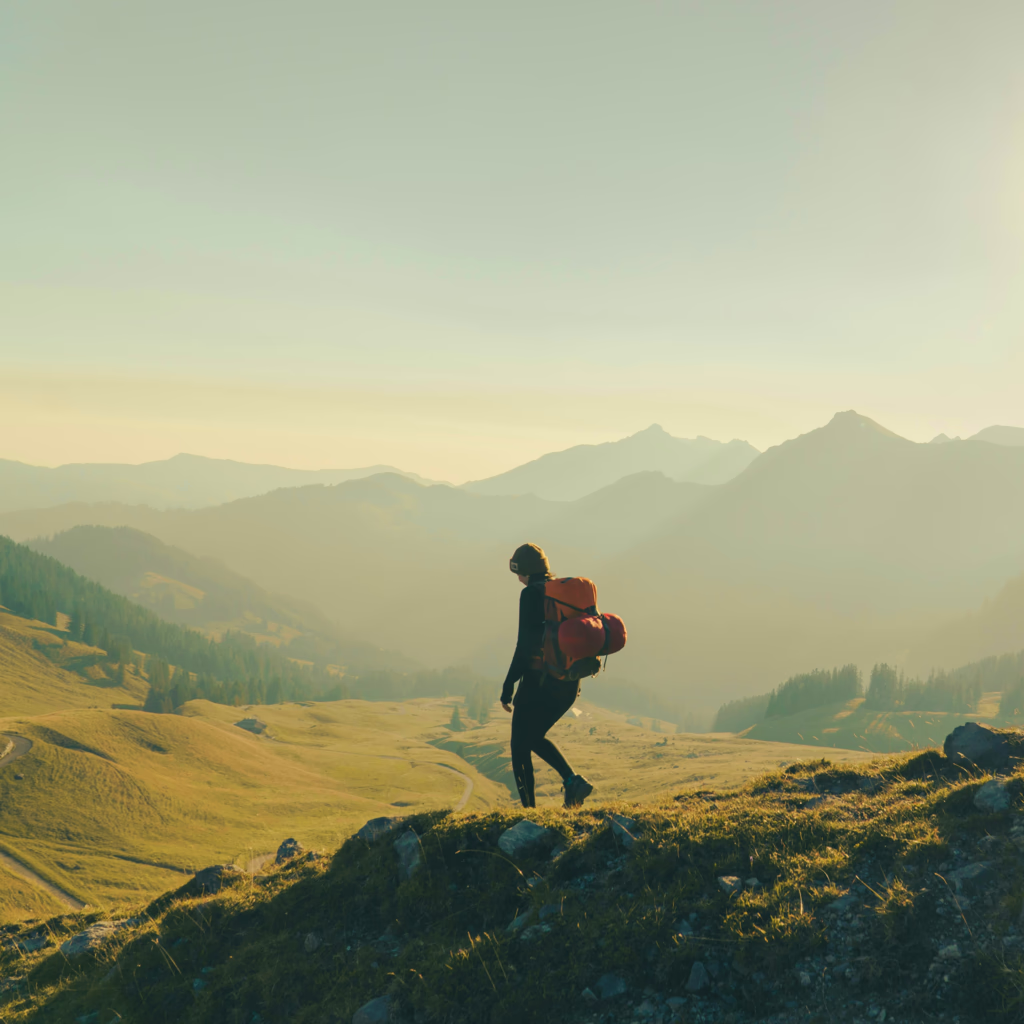
Walk
The self-help industry is worth $14 billion annually. If it worked, it would have put itself out of business by now.
The books tell people to wake up at 5 a.m., to journal, to meditate, to set goals, to visualize success—and these are not bad things, but they assume the destination is correct and only the vehicle is broken. They optimize people for a race that shouldn't be run. They make more efficient prisoners.
A person who has spent forty years pretending to learn, working jobs that hollowed them out, accumulating responsibilities they never chose—this person doesn't need another productivity system. They need permission. They need permission to stop. To question. To grieve what was lost. To begin again at sixty, at seventy, at any age, because beginning is not reserved for the young.
Narrated Books Work
Most people will never read Thoreau. The overworked parent, the exhausted laborer, the person whose schooling taught them that books were punishment—they will not sit down with Walden. But they might listen to it while driving, while washing dishes, while lying awake at 3 a.m. wondering if this is all there is.
Audiobooks are not a lesser form. They are the return to the original form—the oral tradition, the elder speaking to the tribe around the fire. Socrates never wrote a word. Wisdom was spoken before it was written, and for many people, it must be spoken again.
The path exists:
- Man's Search for Meaning by Viktor Frankl
- God Is Not Great by Christopher Hitchens
- The Demon-Haunted World by Carl Sagan
- The Story of Philosophy by Will Durant
- The Giants of Philosophy read by Charlton Heston
- A Walk In The Woods by Bill Bryson
- Into The Wild by Jon Krakauer
These are not self-help books. They are self-finding books. They don't optimize you for the machine. They ask whether you should be in the machine at all.
Walking Is The Cheapest Upgrade
The science is clear now: walking changes the brain. It integrates the hemispheres, reduces cortisol, induces mild meditation, creates space between stimulus and response. But more than the science—walking is human. We walked for two hundred thousand years before we sat in cubicles. The body remembers.
A person doesn't need to hike the Triple Crown. They need to walk around the block. Then walk farther. Then find a trail. The trail will teach them especially with a book playing in ther ears—that they are capable of more than they believed, that discomfort is not death, that there is a self beneath the exhaustion that has been waiting for them.
The Question, Not the Answer
The overwhelmed do not need more answers. They are drowning in answers—from advertisers, from politicians, from algorithms, from everyone who wants something from them. What they need is the question.
One question, asked sincerely, can undo decades of programming:
Is this actually what I want, or what I was taught to want?
That question is a key. Most people have never asked it, not really. They've complained, they've wished things were different, they've fantasized about escape—but they haven't sat with the question and let it do its work.
The question doesn't require education. It doesn't require money. It doesn't require permission. It only requires a moment of silence long enough to hear it.
For Everyone Who Is Tired
You don't need another list. You don't need to wake up earlier or drink more water or finally start that journal they've been telling you to start since you were seventeen.
You don't need to optimize what shouldn't exist. You don't need to be more efficient at things that are killing you.
Stop.
I know they taught you that stopping is laziness, that rest is earned and you haven't earned it, that somewhere out there people are working harder than you and they will take what is yours if you slow down for even a moment.
This is the lie. This is the central lie around which all the other lies orbit like dead planets around a cold star.
You are not a machine. You are not a resource. You are not a human doing. You are a human being, and you have been so busy doing that you have forgotten how to be.
The things you were taught to want— the career, the house, the car, the right schools for children you were too tired to know, the retirement that glimmers like a mirage in a desert you're not sure you'll survive—
these were not your ideas.
You absorbed them the way you absorbed your parents' fears, the way you absorbed the television's version of what a life should look like, the way you absorbed a thousand commercials before you were old enough to know you were being sold.
And now you carry them like stones in your pockets, wondering why you're sinking, wondering why the water is rising, wondering why you can't remember what you actually wanted before they told you what to want.
Put down the stones.
I know it feels impossible. I know they feel like you— like without them you would dissolve, like without the wanting there would be nothing left.
But there is something left. There is something underneath the job title and the mortgage and the responsibilities you accepted because you didn't know you could decline.
There is a self that watched all of this happen. A self that has been waiting, patient as a mountain, for you to get tired enough to finally sit down and ask what it knows.
You don't have to burn your life down. You don't have to abandon everything and walk into the wild like so many of us have dreamed of doing in our most desperate moments.
You just have to start asking questions that have no immediate profit.
You just have to take walks that have no destination.
You just have to read one book— one real book, not the ones they assigned, not the ones that promise six steps to a better you, but the ones that say I was lost too, and here is what I found.
Thoreau left everything and went to the woods and found that most of what he'd been told was unnecessary, that a man could live on almost nothing if what he was living for was worth the living— and he wrote that down so you would know it's possible.
Marcus Aurelius ran an empire and still found time to write: "It is not death that a man should fear, but he should fear never beginning to live."
He wrote that for you. Two thousand years ago, a Roman emperor looked across time and saw you in your car, in your commute, in your quiet moments of terror when you wonder if this is all there is— and he said: begin.
They wrote these things for you. The great ones always write for the ones who will come later, the ones who are trapped in circumstances unimaginable, the ones who need to know that someone else saw through it too.
Walk. Every day if you can. Let your body remember what it was made for.
Listen. To one book that asks real questions. Let it play in your ears while you do the things you have to do. Let it plant seeds.
Ask. The question that frightens you. Is this what I want? Sit with the silence that follows.
Find one other. One person who sees it too. Not to complain together— to build together. To remind each other that the seeing is not madness.
Begin. Anywhere. The trail is everywhere. Every step away from pretending is a step toward something real.
For the Young Especially
They will try to sort you. They will try to rank you. They will try to convince you that your worth is in your grades, your productivity, your ability to fit into slots they have prepared.
Do not believe them.
Your worth is not in your usefulness. Your intelligence is not measured by tests designed to measure compliance. Your future is not a ladder— it is a wilderness, and you are meant to explore it, not climb someone else's idea of up.
Read what they don't assign. Ask what they don't encourage. Walk where there is no path.
The ones who built this maze do not have your interests at heart. They have their own interests at heart, and you are raw material to them, human resource, a problem to be managed until you are profitable.
You are not a problem. You are not a resource. You are a human being at the beginning of a journey that no one else can take for you.
Do not let them walk it for you. Do not let them tell you where it leads.
Find out for yourself.
Remove.
You have permission to subtract.
Look at the the door you forgot exists.
The journey is simple.
That's what makes it hard.
In a world addicted to complexity, simplicity feels like dying.
Walk. Ask. Listen. Begin.
That's it. That's the whole curriculum.
The rest is what you find when you finally stop for long enough to find it.
Wars are fought by people who do not know themselves, who have been given enemies to distract them from questions, who march because the alternative— sitting still, looking inward, facing the void— is more terrifying than death.
You have to learn to sit with yourself, to find the void and discover it is not empty but full of everything you were taught to fear.
A person who has faced themselves cannot be easily marched. Cannot be easily sold. Cannot be easily convinced that strangers are enemies and that dying for abstractions is noble.
The revolution is not political. It is personal. One person at a time, waking up.
That is slow. That is unglamorous. That is the only thing that has ever worked.