Terminus Six
The only way to make sense out of change is to plunge into it, move with it, and join the dance. —Alan Watts
PART ONE: THE TERMINUS
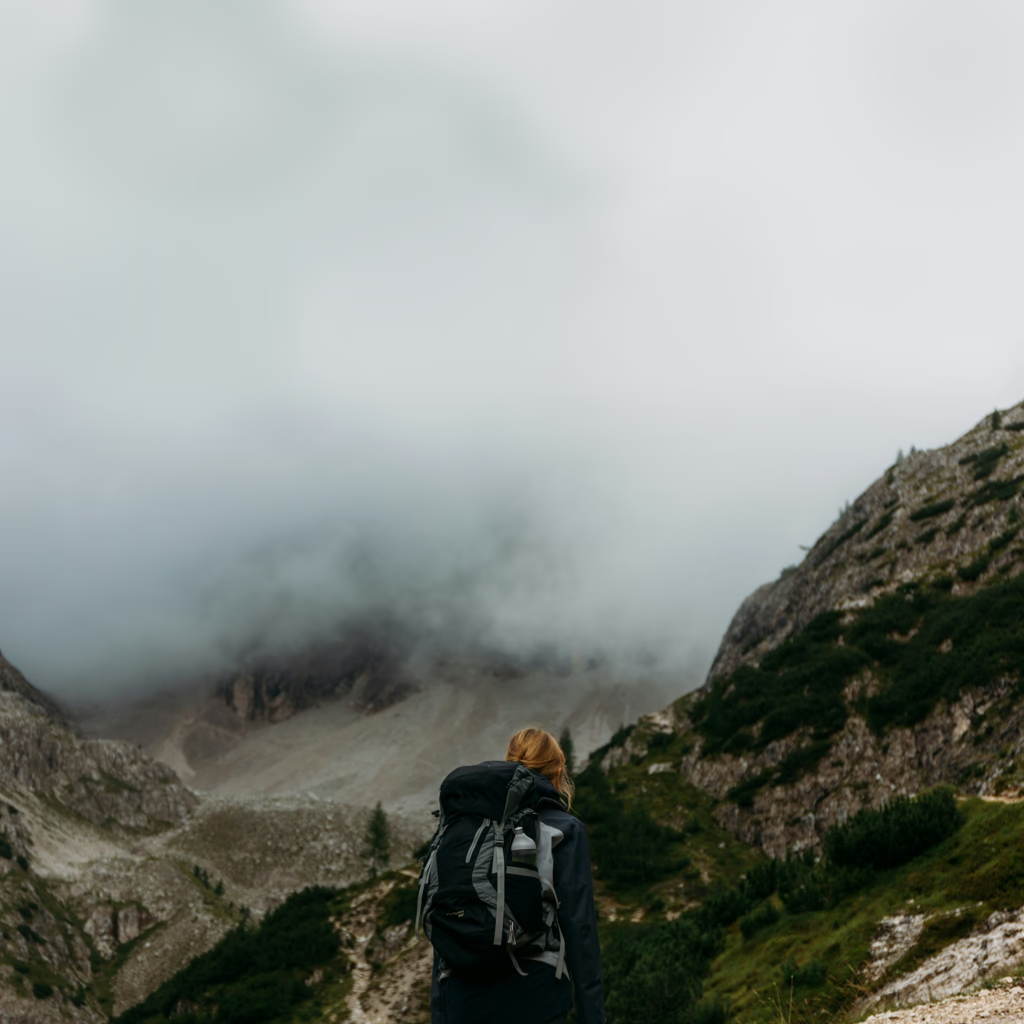
She stood at Chief Mountain on the ninth of September, the wind moving through the aspens like a whispered language she had learned to understand over seven thousand miles. The final cairn of the Continental Divide Trail rose before her—a modest stack of stones marking what the hiking community calls Terminus Six, the northern endpoint of the last great trail in the Triple Crown. Behind her lay the Appalachian, the Pacific Crest, years folded into footsteps, a life compressed and then expanded into something the philosophers once called eudaimonia—human flourishing, the full bloom of a realized existence. Her name was Sophia. She was thirty-one years old. She had just become one of approximately four hundred people to complete the Triple Crown of American hiking.
The granite peaks of Glacier National Park stretched southward in serrated ridges, catching the late afternoon light. To the north, the Canadian border dissolved into more wilderness—endless and indifferent. She sat down on a flat rock, removed her pack, and did something she had not done in all her years on the trail. She wept. Not from exhaustion or relief, but from the strange vertigo of completion, the disorientation of having arrived at a destination she had never truly believed in as a destination. The trails had taught her that arrival was an illusion, that all termini were merely points of continuation. But here she was. Terminus Six.
Erik Erikson, the developmental psychologist, wrote that the final stage of human maturity involves what he called ego integrity—the acceptance of one's life as something that had to be, the reconciliation of all one's contradictions into a coherent whole. The philosopher Jane Loevinger refined this further, describing a rare tenth stage of ego development she called the Integrated self—a person who has transcended internal conflicts, who cherishes individuality while recognizing the interconnectedness of all things, who holds opposites in creative tension without collapsing into paralysis or false synthesis. Such individuals, Loevinger noted, are exceedingly rare. Perhaps one in a hundred thousand.
Sophia did not think of herself in these terms. She had not read Loevinger until years later, when a psychologist friend recognized something unusual in her and handed her the research. But sitting at Chief Mountain that September evening, she understood something about herself that required no academic validation: she had walked her way into wisdom. Not cleverness, not information, not the accumulated trivia that passes for knowledge in an age of infinite data—but wisdom, the rarest and most necessary form of human understanding.
The story of how Sophia came to stand at Terminus Six is not a simple narrative of adventure, though it contains adventure in abundance. It is not a tale of escape, though she escaped many things. It is, at its core, a story about authenticity—that overused and under-understood word that Heidegger placed at the center of human existence, that Kierkegaard equated with becoming a true self, that the ancient Greeks embedded in their concept of aletheia, truth as unconcealment, the revelation of what is real beneath the accumulated layers of pretense.
She was born in 1994 in a suburb of Cleveland, Ohio, the kind of place that seems designed by committee to eliminate all traces of the particular, the distinctive, the alive. Her parents were decent people trapped in the machinery of American middle-class striving—her father a regional sales manager for a medical equipment company, her mother an administrative assistant at a community college. They loved her in the limited vocabulary available to people who have been taught that love means provision, protection, and the elimination of risk.
From an early age, Sophia sensed that something was wrong—not with her family, whom she loved, but with the entire apparatus of life as it was being presented to her. The schools seemed designed to extinguish curiosity rather than kindle it, the homework an elaborate ritual of compliance with no connection to genuine learning. The television that dominated her childhood living room broadcast a continuous stream of images that felt to her like a kind of assault—commercials that promised happiness through products, sitcoms that reduced human relationships to predictable rhythms of setup and punchline, news programs that cycled through catastrophe and triviality with the same breathless urgency. "I remember being seven or eight," she would later write in her journal, "and watching my parents watch television, and feeling this terrible sadness. Not because they were doing anything wrong, but because they seemed to be gone—physically present but absent in some essential way. The screen had them. It had taken them somewhere that I couldn't follow, and I knew even then that I didn't want to go."
In 1967, the French philosopher Guy Debord published The Society of the Spectacle, a dense and prophetic analysis of how modern capitalism transforms all of life into representation, into images that mediate our relationship with reality until the image becomes more real than the reality it supposedly depicts. "All that once was directly lived," Debord wrote, "has become mere representation." He could not have anticipated the internet, social media, the infinite scroll of curated lives and manufactured outrage, but his analysis cuts to the heart of the malaise that Sophia intuited as a child: the world she was being inducted into was not the real world. It was a simulacrum, a performance, a vast collaborative fiction maintained by people who had forgotten they were performing.
The advertisements that punctuated every television program, every magazine, every highway, every digital feed spoke in the grammar of desire—you are incomplete, they whispered, you are insufficient, you are lacking, but we have the solution, the product, the purchase that will make you whole. This message, repeated billions of times across billions of impressions, had become invisible through sheer ubiquity. It was the air everyone breathed. Sophia was not immune to it—no one is entirely immune—but some part of her refused to inhale fully.
She read voraciously as a teenager, not the assigned books of school curricula but the books that called to her from library shelves—Thoreau's Walden, Emerson's essays, the poetry of Mary Oliver, the philosophy of Marcus Aurelius. These writers seemed to be speaking across centuries directly to her predicament. "The mass of men lead lives of quiet desperation," Thoreau had written in 1854, and 160 years later, the desperation had not abated—it had merely become more quiet, more medicated, more distracted.
"I went to the woods because I wished to live deliberately," Thoreau explained, "to front only the essential facts of life, and see if I could not learn what it had to teach, and not, when I came to die, discover that I had not lived." These words lodged in Sophia like a splinter, working their way deeper into her consciousness with each passing year. She was not yet ready to go to the woods, but the woods were waiting.
PART TWO: THE UNRAVELING
She attended Ohio State University because that was what one did, choosing psychology as a major because she wanted to understand why people behaved as they did—why they said one thing and did another, why they pursued what made them miserable, why they abandoned what brought them joy. Her professors were intelligent and well-meaning, but the curriculum felt like a map drawn by people who had never visited the territory. The experiments described in her textbooks had been conducted on college sophomores in laboratory conditions, their conclusions extrapolated to all of humanity with a confidence that struck her as both arrogant and absurd.
"I remember sitting in Introduction to Social Psychology," she later recalled, "learning about conformity experiments and obedience studies, and thinking: everyone in this room is conforming right now. Everyone is obedient. We're studying these phenomena as if they were curiosities, specimens under glass, while enacting them with every choice we make. The professor talked about Milgram's experiments as if they revealed something shocking about human nature, but nobody mentioned that we were all doing exactly what we were told, taking notes, memorizing facts, preparing for tests that would determine our futures. The irony was suffocating."
She graduated with honors in 2016 and took a job at a market research firm in Chicago because it was the kind of job one took—respectable, professional, a first rung on the ladder to wherever ladders were supposed to lead.
The work involved analyzing consumer behavior, identifying the psychological triggers that could be leveraged to increase sales of products ranging from soft drinks to automobiles. She was, she realized with mounting horror, being paid to refine the machinery of manipulation that had troubled her since childhood.
The office culture operated according to unwritten rules that everyone understood and no one examined. Ambition was expressed through the performance of busyness, through staying late and arriving early, through the accumulation of metrics that could be cited in performance reviews. Her colleagues spoke in corporate euphemisms—"circle back," "leverage synergies," "move the needle"—language designed to obscure rather than communicate, to create the impression of progress while preventing any genuine examination of what was being progressed toward. "What struck me most," Sophia wrote, "was how unhappy everyone seemed beneath the surface of professional competence. The weekend drinking was not celebration—it was recovery. The vacations were not adventures—they were escapes. People complained constantly about their lives while doing nothing to change them, as if complaint were a substitute for action, as if naming the prison somehow freed you from it."
The philosopher Simone Weil, writing in the 1940s, distinguished between what she called attention and will. Will, she argued, was overrated—the mere exertion of effort in a predetermined direction. Attention was infinitely more valuable: the patient, receptive opening of oneself to reality, the willingness to see what is actually there rather than what one wishes or fears or expects to see. Most people, Weil observed, never truly paid attention to anything. They moved through life in a kind of waking sleep, reacting to stimuli, pursuing programmed goals, mistaking their habits for choices.
Sophia began to pay attention. She observed her coworkers with the detachment of an anthropologist studying a foreign tribe. She noticed how the open-plan office eliminated privacy while creating the illusion of collaboration, how the ping of notifications kept everyone in a state of continuous partial attention, how the very architecture of the workplace was designed to prevent the kind of deep, sustained thinking that might lead to genuine insight or dangerous questions. She noticed, too, the messages that saturated her environment—the billboards on her commute promising whitened teeth and luxury vacations, the targeted advertisements that followed her across the internet with uncanny precision, the feeds of former classmates displaying lives of carefully staged fulfillment. The entire apparatus seemed designed to cultivate dissatisfaction, to ensure that no one ever felt sufficient, that the solution to every inadequacy was a product, a service, a purchase.
Albert Camus, in The Myth of Sisyphus, wrote that the fundamental philosophical question was whether life was worth living—whether, in the face of absurdity and inevitable death, suicide was the logical response. Sophia did not contemplate suicide, but she understood what Camus was getting at.
The life being offered to her—the career, the consumer goods, the curated social media presence, the eventual mortgage and 401(k) and retirement community—struck her as a kind of slow death, a gradual extinction of everything vital and questioning and alive. "One must imagine Sisyphus happy," Camus concluded, and this seemed to Sophia both profound and insufficient. Sisyphus could be happy because he had no choice—the boulder would roll back down, and he would push it up again, forever. But she had a choice. The boulder was optional. The mountain was one of many.
The breaking point came, as breaking points often do, not through dramatic crisis but through accumulated weight. It was a Tuesday in March of 2019. She was in a conference room with frosted glass walls, presenting findings on consumer sentiment toward a new energy drink. The brand wanted to target young professionals who felt exhausted by their demanding lifestyles—which is to say, they wanted to sell caffeinated sugar water to people whose exhaustion was caused by the very system the brand perpetuated. The irony was too precise, too suffocating. She excused herself, walked to the bathroom, and looked at her reflection in the mirror. The person staring back was familiar but strange—professionally dressed, competently groomed, appropriately accessorized, entirely hollow. She thought of Thoreau's cabin at Walden Pond, of Mary Oliver's question: "Tell me, what is it you plan to do with your one wild and precious life?"
The answer came not as a decision but as a recognition: she was going to walk. She didn't yet know how far or for how long, but she knew with sudden certainty that walking was the answer to the question her entire life had been posing without her knowledge. The philosophers had written about walking: Kierkegaard's daily constitutional through Copenhagen, Nietzsche's dictum that only thoughts arrived at while walking had value, Rousseau's reveries, Wordsworth's wanderings. Walking was humanity's original form of travel, the rhythm that had carried the species out of Africa and across the globe. It was, perhaps, the only honest way to move through the world.
Two months later, she stood at Springer Mountain in Georgia, her hand on the bronze plaque marking the southern terminus of the Appalachian Trail. She had sold her car, given notice at her job, told her bewildered parents that she needed to do this and could not fully explain why. Her pack weighed thirty-two pounds. She had four months of supplies arranged for mail drops along the trail's 2,190-mile length. She was terrified and exhilarated and, for the first time in years, completely present.
PART THREE: THE TRAIL AS TEACHER
The Appalachian Trail does not give up its gifts easily. The first weeks tested Sophia in ways she had not anticipated—blisters that made each step a negotiation, muscles that screamed with unfamiliar effort, rain that soaked through every layer and left her shivering in shelters that leaked. The romanticized notion of wilderness that she had carried from Thoreau and Muir dissolved into the reality of mud, monotony, and the thousand small miseries of the body. But something else was happening, something that the discomfort could not obscure. Her mind was changing. The incessant chatter that had filled her consciousness—the anxieties, the self-criticisms, the endless loops of planning and regretting—began to quiet. In its place emerged a quality of attention she had never experienced, a presence to the immediate moment that felt almost supernatural after years of distracted living.
"The first hundred miles, I was still thinking in the old way," she wrote in her journal. "I was calculating how far I had to go, worrying about whether I was on pace, comparing myself to other hikers. Around mile 150, something shifted. I stopped thinking about the destination and started experiencing the journey. Each step became complete in itself. The trail wasn't leading somewhere—it was the somewhere." The Zen teacher Shunryu Suzuki distinguished between what he called "beginner's mind" and "expert's mind." The expert, having accumulated knowledge and technique, approaches each situation with preconceptions, with categories, with solutions already prepared. The beginner approaches with openness, with curiosity, with the willingness to be surprised. "In the beginner's mind there are many possibilities," Suzuki wrote. "In the expert's mind there are few."
Sophia was becoming a beginner again. The trail stripped away her accumulated certainties, her reflexive interpretations, her mental shortcuts. She had to pay attention to where she placed each foot, to the angle of the sun, to the sounds that indicated weather or wildlife or danger. This attention, initially a survival mechanism, became a practice, a discipline, a way of being in the world.
She reached Katahdin on September 3rd, 2019, having walked 2,190 miles in 147 days. The summit was crowded with day hikers snapping photographs, and she felt a pang of the old alienation—these people with their selfie sticks and hashtags, documenting rather than experiencing, performing their adventures for invisible audiences. But the feeling passed quickly. She could not judge them. They were doing what they knew how to do, moving through the world in the only way their culture had taught them. She had been one of them, not so long ago.
The Pacific Crest Trail was different. Where the Appalachian wound through ancient forests and intimate valleys, the PCT crossed vast expanses of desert and high sierra, landscapes of geological violence and sublime indifference. The trail ran 2,650 miles from Mexico to Canada, through California, Oregon, and Washington, climbing and descending a cumulative 420,000 feet of elevation.
She began in April of 2020, just as the world was shutting down for the pandemic. The timing was accidental but fortuitous—the trail was emptier than usual, the permit system simplified, the small towns along the route eerily quiet. She walked through a world in crisis, carrying only what she needed, self-sufficient in a way that most people could not imagine.
The desert taught her about water—how to carry it, how to find it, how to respect its absence. The Sierra Nevada taught her about snow—how to navigate it, how to fear it appropriately, how to move through landscapes of blinding white that seemed to exist outside of time. The volcanic ranges of Oregon taught her about fire—the burn scars that transformed forests into ghostscapes, the ash that fell like grey snow during the region's worst wildfire season in recorded history.
"I walked through smoke for three hundred miles," she wrote. "The sun was red, the air tasted of destruction, and I thought about how the world was burning while most people couldn't see it. Not just the forests—everything. The climate, the politics, the social fabric. But on the trail, you see the burning directly. You can't look away."
The philosopher Iris Murdoch argued that the central task of moral life was attention—the patient, loving regard for what is truly other, what exists independently of our wishes and projections. Most people, Murdoch observed, lived in a fog of self-centered fantasy, seeing only what confirmed their existing beliefs, filtering reality through the lens of ego. True vision required discipline, practice, the cultivation of what Murdoch called "unselfing"—the gradual diminishment of the fat, relentless ego.
The trail was unselfing Sophia. Mile after mile, she felt the boundaries of her ego growing thinner, more permeable. She was not disappearing—quite the opposite—but she was becoming less defended, less armored against experience. The beauty of a sunrise over the Cascade volcanoes could move her to tears. The sight of a coyote hunting in a meadow could stop her for an hour of watching. She was becoming porous to the world. She reached the Canadian border on September 19th, 2020. The monument at the terminus—a wooden post with a metal marker—seemed almost anticlimactic after 2,650 miles. She sat beside it for several hours, watching the light change, feeling the immensity of what she had done and the equal immensity of what remained. The Continental Divide Trail was waiting.
PART FOUR: THE GREAT DIVIDE
The Continental Divide Trail is the longest and most challenging of the Triple Crown trails—3,100 miles along the spine of the Rocky Mountains from Mexico to Canada, much of it unmaintained, much of it requiring navigation skills that the other trails do not demand. It is the trail that separates casual thru-hikers from devotees, the trail where weather can kill you and solitude can break you and the sheer scale of the landscape can reduce even the most confident hiker to insignificance. Sophia began her CDT hike in April of 2023, starting from the southern terminus at Crazy Cook in New Mexico's Chihuahuan Desert. She was thirty years old. She had spent the intervening years working seasonal jobs—trail maintenance, wilderness guide, hostel staff—anything that kept her close to the outdoors and away from the corporate world she had fled. Her body had transformed into an efficient machine for walking, her mind into an instrument of attention and presence.
The CDT tested her in new ways. The route was often ambiguous, requiring hours of navigation with map and compass through terrain where a wrong turn could add days to her journey or lead her into genuine danger. The elevation was relentless—she spent weeks above 10,000 feet, her lungs burning in the thin air, her body adapting to altitudes that would leave most people gasping and dizzy.
"The CDT taught me about uncertainty," she wrote. "The other trails had clear tread, maintained paths, a confidence that you were going the right way. The Divide has none of that. You're constantly questioning, constantly correcting, constantly humble. And somehow that uncertainty became comfortable. I stopped needing to know where I was going. I just went."
Nietzsche wrote of the "great health"—a vitality that could encompass suffering, that could say yes to existence in all its terrible beauty, that could dance at the edge of the abyss. This was not the forced optimism of positive thinking or the denial of pain that consumer culture promotes. It was something fiercer and more honest: the embrace of life as it actually is, with all its darkness and light, its cruelty and grace.
Sophia was developing the great health. A thunderstorm that would have terrified her five years ago now seemed magnificent, a display of forces that dwarfed human concerns. A lonely night in a high meadow, surrounded by darkness and the sounds of unseen animals, was no longer lonely—it was full, pregnant with presence, more intimate than any crowded room. She was learning to be alone without being lonely, to be small without being diminished.
In late August, she entered Glacier National Park for the final stretch to Chief Mountain. The landscape was spectacular even by the standards of the trail—towering peaks, turquoise lakes, glaciers clinging to mountainsides in their final decades before climate change erased them entirely. She moved through this beauty with a grief that had become familiar, the sorrow of witnessing what was being lost even as she celebrated what remained.
The grief was not despair. The philosopher Jonathan Lear, writing about the destruction of the Crow Nation's traditional way of life, distinguished between "radical hope" and optimism. Optimism expects good outcomes; it is a prediction about the future. Radical hope is something deeper and more resilient—the commitment to a future goodness that transcends our current ability to understand or imagine it. The Crow chief Plenty Coups, facing the end of everything he knew, held to a radical hope that his people would find a way to flourish in circumstances he could not foresee.
Sophia carried a radical hope through Glacier. She did not know what the future held for the planet, for humanity, for the wild places she had come to love. But she knew that despair was a luxury she could not afford, and that hope was not passive waiting but active engagement—each step a vote for possibility, each mile a refusal to surrender to the forces of destruction.
PART FIVE: WHAT THE TRAIL REVEALS
What do seven thousand miles of walking teach you? The question is inadequate—like asking what breathing teaches you, what loving teaches you. The lessons are not separable from the living. They are embodied, cellular, inseparable from the rhythm.
But if Sophia were forced to articulate what she had learned, she might begin with this: most of what passes for reality in contemporary life is performance. The careers, the consumer goods, the social media personas, the carefully curated images of success—all of it is a kind of theater, a collective agreement to pretend that these things matter in the ways they claim to matter. The trail strips away this pretense. Your body either can or cannot carry you forward. Your gear either functions or fails. The weather cares nothing for your opinions about it. "There's no brand loyalty on the trail," she wrote. "Nobody cares what label is on your pack or whether your tent is this year's model. Things work or they don't. You learn very quickly what matters and what's just marketing. And then you start to see that most of life is marketing—that we've been sold a vision of reality that benefits the sellers and impoverishes the buyers."
The Stoic philosophers of ancient Rome—Marcus Aurelius, Seneca, Epictetus—distinguished between what is "up to us" and what is not. Our opinions, our impulses, our desires, our aversions—these are up to us. The weather, other people's behavior, the circumstances of our birth, the length of our lives—these are not. Freedom, the Stoics argued, consists in accepting what is not up to us while taking full responsibility for what is.
The trail enforced a Stoic discipline. Sophia could not control the weather, the condition of the path, the presence of predators or dangerous stream crossings. She could control her response, her preparation, her attitude, her choice to continue or retreat. This distinction, theoretical in philosophy, became practical wisdom on the trail. She stopped wasting energy on what she could not change and focused entirely on what she could.
The trail also taught her about community—a word she had once associated with organized activities and forced togetherness. The thru-hiking community was different. It formed spontaneously among strangers who shared a common project, who helped each other without expectation of return, who recognized kinship in the simple fact of walking the same direction.
"Trail names were part of it," she explained. "You'd meet someone and they'd be 'Mosquito' or 'Patches' or 'Wrong Turn,' and you knew them by their trail names, their trail identities, who they were on the trail rather than who they were in their other life. It was liberating. You could reinvent yourself, or you could finally be yourself—without the weight of your resume or your social position or your family's expectations."
Her own trail name was "Philosopher," given to her by a fellow hiker who had listened to her talk about Thoreau and Marcus Aurelius one evening in a shelter. She accepted it with a smile, though the name made her uneasy. She didn't feel like a philosopher—she felt like a student, a seeker, someone who had found the questions but was still working out the answers.
PART SIX: THE INTEGRATED SELF
Jane Loevinger's stages of ego development describe a progression from the most basic forms of self-organization toward increasingly complex, differentiated, and integrated ways of being in the world. Most adults, her research suggested, reach the "Conscientious" stage—they have internalized rules and standards, they feel guilt when they fail to meet their own expectations, they can take multiple perspectives on situations. This is normal, healthy adult functioning. Beyond this, Loevinger identified several higher stages that relatively few adults reach. The "Autonomous" stage involves the recognition of the complexity of others and the world, a tolerance for ambiguity, a capacity for self-reflection that goes beyond mere self-criticism. The "Integrated" stage—the highest Loevinger described, and the rarest—involves the reconciliation of inner conflicts, the cherishing of individuality without narcissism, the capacity to hold opposites in creative tension.
Integrated individuals, according to Loevinger's research, are exceedingly rare. They have typically faced and worked through significant adversity. They are often drawn to the helping professions or to creative and intellectual work. They tend to have rich inner lives, though they may also experience a certain loneliness—the loneliness of having moved beyond the frameworks that organize most people's lives.
Sophia, standing at Chief Mountain on that September evening, did not know that she had reached the Integrated stage. She knew only that she felt whole in a way she had not felt before—not complete, not finished, but whole. The contradictions that had plagued her youth—her simultaneous need for solitude and connection, her desire for adventure and stability, her love of humanity and her alienation from its institutions—no longer felt like problems to be solved. They were aspects of a self that included them all, that had room for them all. "I used to think I had to choose," she wrote in her final trail journal entry. "Career or meaning. Society or authenticity. Love or freedom. The trail showed me that these were false choices, constructs of a culture that profits from our fragmentation. I am not either/or. I am and/also. I am alone and connected. I am small and vast. I am finished with this trail and just beginning."
The sun was setting over Chief Mountain when she finally gathered her things and began the descent toward the parking lot where her friend would be waiting to drive her back to what people called the real world. She walked slowly, savoring these final miles of trail, the familiar rhythm, the quality of attention that had become her natural state.
She thought about what lay ahead. She would write, she knew—there were books in her, stories that needed telling. She would teach, perhaps, sharing what the trail had taught her with people who couldn't walk seven thousand miles but might find shorter paths to the same truths. She would advocate, in whatever way she could, for the wild places that had saved her life.
But mostly, she would continue to walk. Not necessarily on trails—life itself was a trail, if you approached it with attention and presence. Every step a choice, every day a summit or a shelter or a river crossing. The destination was never the point. The walking was the point. It had always been the walking.
The philosopher Martin Buber wrote of "I-Thou" encounters—moments when we meet another being not as an object to be used but as a presence to be encountered, a mystery to be revered. These encounters, Buber believed, were the substance of authentic life. They could happen with people, with nature, with works of art, in holy places like the termini. They required only attention, presence, the willingness to be changed by what we meet. Sophia had spent seven thousand miles in I-Thou encounter with the world. She had met mountains and rivers, thunderstorms and sunrises, coyotes and bears and a thousand human beings walking the same direction. She had been changed by these meetings, made more herself through contact with what was not herself.
The parking lot came into view as the last light faded from the sky. Her friend's car was there, headlights on, waiting. Sophia paused at the edge of the trail, the boundary between wilderness and civilization, the threshold she had crossed so many times in so many directions. She thought of all the people still trapped in the performance of contemporary life—the endless striving, the manufactured desires, the quiet desperation that Thoreau had diagnosed nearly two centuries ago. She could not save them. She could only offer what she had learned, and hope that some would hear.
The trail continued, she knew, even where there was no trail. The walking continued, even when you stood still. The journey continued, even at Terminus Six.
Especially at Terminus Six.
She stepped off the trail and walked toward the waiting car, carrying nothing but what she needed, prepared for everything that came next.