·

#0197: The Future Doth Sneak

A long narrative of humanity’s future, imagining a unified language and internet linking generations into space exploration, culminates in an anecdote about a centuries‑old credit‑card debt that eventually funds the first starship named for its original holder.

·

#0196: Of Political Systems

The post compares a city’s institutions to interlinked computer programs that depend on each other for proper operation, using examples of human‑powered machines such as trash trucks and unmanned aircraft to illustrate how people act like CPUs in these systems. It argues that when the education system fails, it triggers crime and social collapse, showing how one institutional breakdown can ripple through a city. To restore balance, institutions must coordinate and keep their integrity, with the justice system scaling with schools’ performance rather than simply punishing failures. Finally, the piece stresses that human‑powered institutions carry “heart” – prioritizing the poor, ill, homeless, and uneducated by providing homes, care, and business opportunities for students – an approach he calls “Love Above Law.”

·

#0195: World School

The post proposes an open‑school system that eliminates traditional grades and standardized tests, allowing students to pursue self‑chosen learning paths across all subjects—from biology to software engineering—by following industry standards and creating individualized curricula, resumes, and job postings; it envisions a simple, blockchain‑based software platform that tracks progress, offers scholarships and monetary incentives, fosters cultural convergence and knowledge preservation, and ultimately aims to unite humanity around shared truths while addressing poverty, education, climate, and incarceration.

·

#0194: Real Education is Sweet Exploration

The author contends that true learning is a personal adventure sparked by curiosity rather than the rote, grade‑centric system of conventional schools; he urges students to seek knowledge in libraries, audiobooks, documentaries, and influential works such as *Sapiens*, *Cosmos*, and *A Brief History of Time*—and to pair this self‑directed study with entrepreneurial projects that let them build their own ideas; by supporting each other’s independent paths and ensuring no one drops out, he believes we can all become “Great Beings” through empowered, lifelong learning.

·

#0193: Real Education Should Be Your Own Creation

In my dream I saw schools as a manufactured system that steals knowledge, but upon waking I realized true education must be self‑made and called for a change toward personal learning rather than standardized testing.

·

#0192: The Dr. Meow College of Medicine, Certificate of Achievement

The post is a celebratory note that uses the repetitive phrase “So as long as you…” to remind and encourage people—students, friends, and anyone—to embrace happiness, help others, set realistic goals, read inspiring books, and maintain cheerfulness throughout life. It celebrates the power of self‑education and gratitude, praises the recipient’s efforts, and ends with a playful “certificate” from “Doctor Meow, Ph.D.” that invites the reader to adopt the title “Doctor … Ph.D.” in their signature.

·

#0191: Voyageur Du Temps

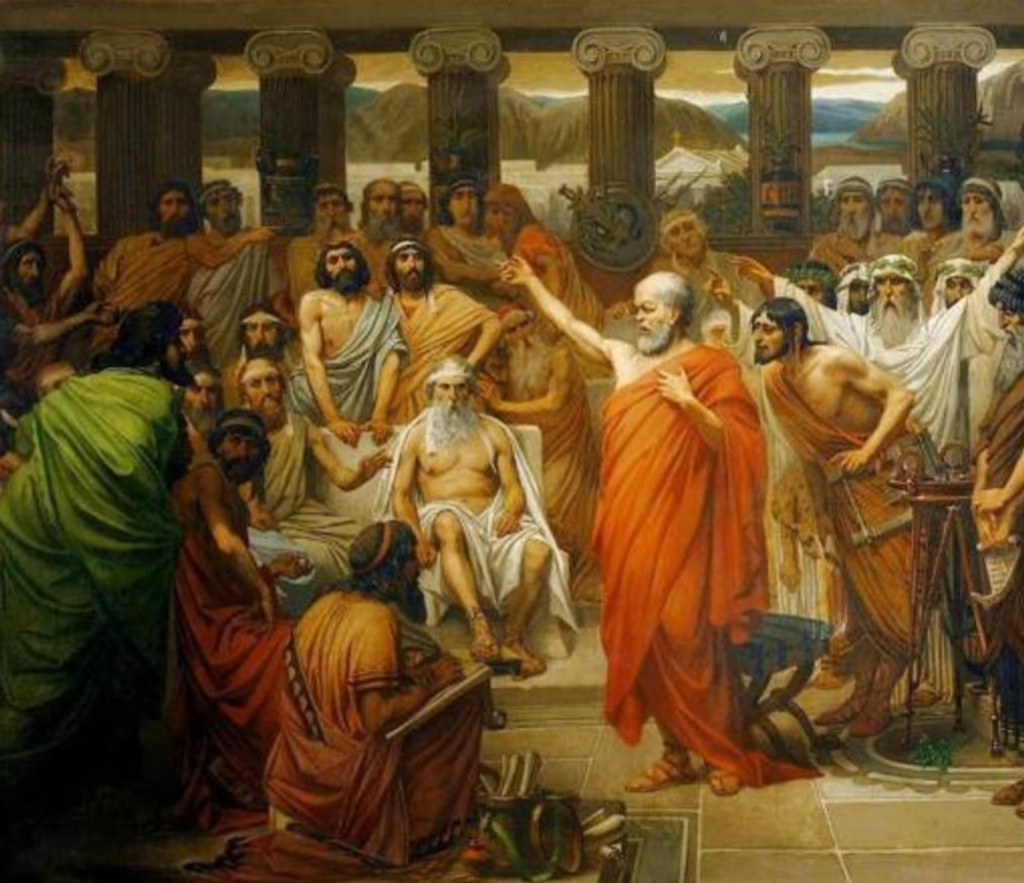
The post describes a whimsical journey back in time to 425 BC where the narrator watches Socrates teaching by the sea, emphasizing that learning is about piecing together lessons while ignoring what’s unimportant. It then returns to the present and reflects on how true education requires real knowledge rather than just grades or “fake” schooling, urging readers to seek authentic lectures and books, stay focused on wisdom, and remember their own inner “elder self.”

·

#0190: 3,900 Tigers

The post argues that human “genius”—our unique self‑awareness, adaptability, and capacity for learning—is the key to solving global problems. It explains how limited knowledge shapes our reality, using examples from past eras and child development, and stresses that culture’s influence on what we consider real is profound. By continually speaking and reflecting, each of us can expand our understanding, correct mis‑education, and awaken our inner genius. The author urges readers to embrace books, quiet their lives, and let this “genius” guide them toward deeper wisdom so that humanity can rise from its current crises and give children a fair start in life.

·

#0189: Web Pages For Ages

A writer reflects on their long journey of learning web design and programming, starting in 1999 and continually expanding their skills through many languages and tools. They describe how mastering command line basics, color theory, layout, and finishing touches has shaped their craft, noting the value of understanding history even as new techniques emerge. The narrator feels that while much remains to learn—especially about colors and visual effects—the process is manageable, and they’re confident enough to write a book on their experience.

·

#0188: Yes Library

In this poetic reflection, the author celebrates academic rituals—deans nodding to coffee‑drinking graduates—and then turns to a more intimate scene: a mother bringing her child to the library, turning it into a personal temple of knowledge where non‑fiction and memoirs become the safest paths for growth. The piece emphasizes learning in stages—from simple to profound—to build a solid ramp toward understanding, while stories of triumph and disaster provide lessons already tried by countless others. It frames school as a dreamed universe whose true institution is our responsible mind, capable of excellence when nurtured by love and self‑compassion. Finally the author links this personal cultivation to world peace, asserting that only through children becoming great beings under calm skies can we hope for lasting harmony.

·

#0187: No University

This essay argues that true growth comes from continuous personal learning rather than formal university degrees; it urges each person to pursue “wisdom” through self‑study, audio books, video lectures, and real‑world experience, believing that such knowledge is more powerful than grades or prestige. The author insists that every individual must take responsibility for their own education—pulling themselves up by the bootstraps of curiosity and practice—and then share what they learn to empower others. By doing so, we can collectively build a “wise humanity” capable of solving today’s complex problems (war, poverty, climate change) and creating world peace and human rights. In short, the post calls for a shift from institutional learning to self‑driven mastery of wisdom that benefits all people worldwide.

·

#0186: Nordhouse Dunes

This poem reflects on the enduring rhythm of life and learning, urging us to embrace its long, winding path with patience and purpose. It reminds us that we are never truly alone, that effort can turn a mistake into rightness, and that travel—both in physical journeys and intellectual ones—is driven by what we learn, love, and know. The verses invite a slow, mindful pace: to observe nature’s rhythms, to write, share discoveries, and to let creativity flow like a quiet book of poems. In the end it encourages us to return home with fresh ideas, a cozy nook, and a cup of chocolate, celebrating that life is richest when lived slowly and thoughtfully.

·

#0185: Of Mountain Ranges And Tipping Points

When you gather enough observations, you move from being an observer to becoming a creator—a transition that mirrors arriving in a new city where initial uncertainty turns into home‑like familiarity. In politics this comfort can become manipulation, while in reading you grow friends with authors who become like family. Adventure stories describe becoming native and working hard until your visa expires before returning to the noisy city. Internalized knowledge becomes wisdom, allowing synthesis and turning listening into active thinking; each tipping point builds capability and unique syntheses that feel amazing. Understanding others’ work lets us share with fellow creators, making us specialists who share discoveries and memoirs—this is real education.

·

#0184: Where To Begin

Beginning with the noble figures of Hypatia, Socrates, and Giordano Bruno, the post urges us to learn through books, audiobooks, libraries, and other cultural institutions—drawing inspiration from thinkers such as Ayn Rand, Avital Ronell, and Martha Nussbaum—and to recognize our mind’s sacred right to preserve its integrity, completeness, and beauty. It calls for peaceful resistance like a great warrior, turning inner peace into a superpower against those who belittle or threaten us. The writer proclaims that we are the hope and dream of the greatest minds, awakened by those same thinkers, and that we must not become victims of indoctrination but instead build a world of clarity through anticipation and prevention, lest leadership failures usher in dark ages. By inheriting knowledge from audio books, internet lectures, museums, galleries, and other media, we can rise to become great beings, achieve world peace, and foster multicultural convergence on wisdom while remembering that only through knowledge can humanity truly grow.

·

#0183: Temporary Residents: A Call To Wisdom

The author reflects on the transient nature of our generation and urges that Earth belongs to all future peoples, so we must act as temporary residents who shape tomorrow’s world. He calls for a new education for children—one that abandons memorization, rigid rows, and meaningless squares, and instead rewards respect, foresight, love, and wisdom; this will prevent crime, end poverty, and unite borders in peace. Hard work, careers, and luxury are irrelevant if we ignore the problems of children, because the world will wait for successive generations of wise beings to converge ideas that earn respect and bring lasting peace. In short, the post invites us all to rise to the challenge and become great beings through real education and love of wisdom.

·

#0182: Philo Sophia Means Love of Wisdom

The post celebrates the human mind as beautiful yet ever‑evolving, arguing that continual learning, insight, and self‑correction are essential for true philosophy. It contends that philosophers work at the edge of their limits and must be scrutinized and refined by others; therefore we should become philosophers ourselves to bring light through knowledge. By mastering these teachings we shape our decisions, lead rather than follow, and can inspire younger generations toward genius.

·

#0181: Find A Library

The post argues that the greatest weapon of any enemy is control over what people know, and even without an explicit foe we can fall into ignorance by relying on incomplete or biased education. It stresses that good intentions alone are insufficient if knowledge is missing, leading to wrong decisions. The author claims that true learning must be self‑directed: find a library, read widely, especially in the philosophy section, and become your own teacher so you can help others grow; only then will education truly be a right, treasure, honor and reward.

·

#0180: Breach All The Tipping Points

The post argues that the answer to “how far must I go?” is simply “higher” – a call to keep shouting it aloud because every moment is a precious miracle. It urges not to be stalled by teachers, bosses, or grades but to break all limits and rise repeatedly. By reading many books, recording what works, and then writing one’s own, we continually move forward; the walls of A‑grades, promotions, and office windows must fall. In short, find your limits, build your way out, grow until you become a “Great Being,” and only then can you truly know where to go next.

·

#0179: A Little Rainy Day

On a rainy morning that still felt like a workout, I set out to jog along Ford Road, braving the sudden downpours that first dripped onto my head and then drenched me fully—yet I kept going, feeling vigorous even as the rain intensified. The storm’s brief break gave way to another burst of heavy showers, but I ran on, energized by the challenge. Along the way I encountered geese that reminded me of the noisy birds from my hometown, though those at the Mall seemed more placid and friendly. Despite the wetness and the flurry of birds, the day’s rhythm carried on, and by afternoon the clouds cleared to reveal a bright sun.

·

#0178: Greatness Is Your Right

Reading and listening to books light up our lives like a beacon in darkness, giving us words when we’re tired and strength when we can’t go on; they bring wisdom, unbreakable spirit, and endless possibilities that transform ordinary days into adventures—traveling by boat or bicycle, sleeping by lakes, and living each moment as a precious gemstone—so let the library be your compass and the audiobooks your guide to greatness.

·

#0177: Learning Is Sacred

Learning is presented as essential for both health and personal elevation, thriving on curiosity, joy, and progressive layering of knowledge. The author argues that true education is a self‑guided adventure—built on deliberate achievements rather than rote schoolwork—and that teachers should be admired but not the sole source of learning. By engaging in enjoyable, colorful study and avoiding toxic environments, one can cultivate genuine mastery and genius.

·

#0176: The Practice of Strength

The post celebrates self‑challenge as a deliberate, stepwise practice that builds strength and enlightenment over time. It likens this process to running marathons: each long run is a test of perseverance, and the moment when we finally cross the finish line proves that persistent effort turns seemingly impossible tasks into achievable goals. By embracing varied challenges at different life stages, we grow stronger, wiser, and healthier—each triumph inspiring both ourselves and future generations.

·

#0175: We Are Not To Be Quiet Little Mice, Just To Be Nice

The post describes how intellectual growth unfolds as a cumulative construction of knowledge, driven by curiosity and passion rather than rigid subject divisions. It argues that true learning emerges from a free, interdisciplinary exploration—whether calculating exoplanets or programming—to bring numbers to life and discover new insights. Real education, it says, yields results while fake schooling leaves one exhausted; the key is to pursue self‑directed paths with courage, imagination, and inspired enthusiasm, so that each person’s enlightenment not only enriches themselves but also contributes to humanity’s collective growth.

·

#0174: Conundrum of The Human Condition

The post argues that modern education fails because it lacks true wisdom and relies on rote memorization; without wisdom we cannot judge real results or avoid repeating mistakes, so teaching becomes a mere show of grades rather than genuine learning. It stresses that real education is joyful, satisfying, and poverty‑reducing, and that knowledge must be internalized through immersion (like language learning) rather than forced recall. Good teachers are those who themselves discover and love the subject; they then share this passion to help others truly understand. The author concludes that acquiring wisdom—through personal discovery and active practice—is essential for individuals to navigate life nobly, transform their world, and leave a lasting legacy.